


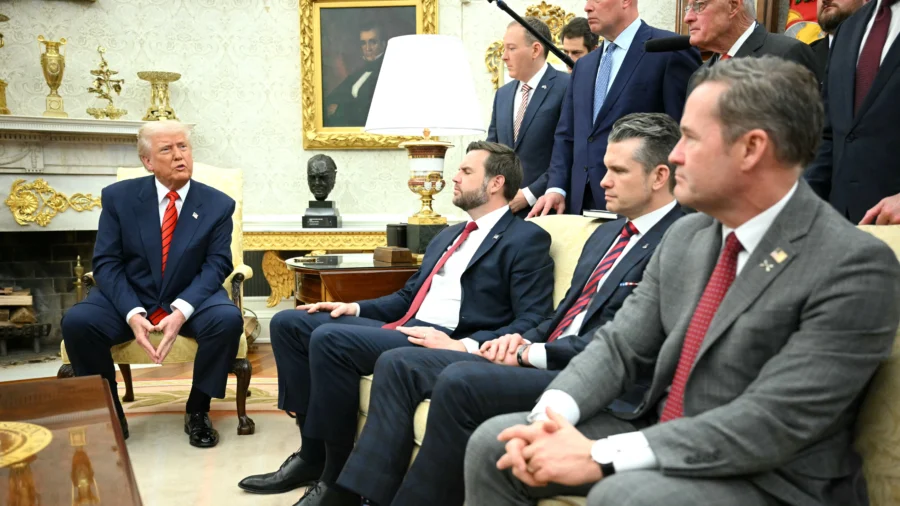
The Atlantic magazine's editor-in-chief was accidentally added to a Trump administration text chat discussing the renewed campaign of U.S. airstrikes on Houthi terrorists in Yemen in the hours after the first bombs dropped, the White House has confirmed.
Goldberg wrote that the Signal user who added him to the group chat, apparently unprompted, was named "Michael Waltz."
"I assumed that the Michael Waltz in question was President Donald Trump’s national security adviser," he wrote.
Goldberg recounted that other names in the group chat included "JD Vance," "TG" (who Goldberg believes was Director of National Intelligence Tulsi Gabbard), "Scott B" (possibly Treasury Secretary Scott Bessent), "Pete Hegseth," "John Ratcliffe," and "MAR" (which Goldberg noted are the initials of Secretary of State Marco Antonio Rubio).
Responding to a request for comment from The Epoch Times, White House National Security Council spokesman Brian Hughes said the group chat that Goldberg was included in looked to be authentic.
"At this time, the message thread that was reported appears to be authentic, and we are reviewing how an inadvertent number was added to the chain," Hughes wrote. "The thread is a demonstration of the deep and thoughtful policy coordination between senior officials.
'Don't Know Anything About It': Trump
When asked about the apparent inadvertent leak of sensitive national security discussions to a journalist, President Donald Trump said he had no knowledge of the episode."I don't know anything about it. I'm not a big fan of The Atlantic. It's, to me, it's a magazine that's going out of business," Trump told reporters at a White House event on March 24. "I think it's not much of a magazine, but I know nothing about it."
Trump has previously clashed with The Atlantic in general and Goldberg in particular.
Internal Discussions Revealed
As the user "Michael Waltz" addressed members of the Signal group chat ahead of the renewed strikes on Yemen, according to Goldberg, he wrote: "Team – establishing a principles [sic] group for coordination on Houthis, particularly for over the next 72 hours. My deputy Alex Wong is pulling together a tiger team at deputies/agency Chief of Staff level following up from the meeting in the Sit Room this morning for action items and will be sending that out later this evening."This message from "Waltz" continued: "Pls provide the best staff POC from your team for us to coordinate with over the next couple days and over the weekend. Thx."
Thereafter, members of the Signal chat submitted names of representatives. For example, "MAR" wrote, "Mike Needham for State," while "TG" wrote, "Joe Kent for DNI," according to Goldberg.
By being included on the Signal channel, Goldberg could read past messages shared in the chat. At about 8:16 a.m. on March 14, the user "JD Vance" wrote that he would be out "doing an economic event in Michigan," according to Goldberg. Indeed, Vice President JD Vance was at a White House event in Michigan that day.
"JD Vance" went on to write, in the same March Signal message, "I think we are making a mistake," according to Goldberg.
The Red Sea represents a key international shipping lane connecting East Africa and South Asia to Europe.
In another message at 8:45 a.m. on March 14, according to Goldberg, "JD Vance" wrote in a message directed at "Pete Hegseth": "if you think we should do it let’s go. I just hate bailing Europe out again."
Calls For Investigation Mount
The leak episode has already met with calls for an investigation.In a Senate floor speech, Senate Minority Leader Chuck Schumer (D-N.Y.) said Signal is an unsecured app that’s not approved for sensitive military operations of the kind that Goldberg was allowed to see.
“This debacle requires a full investigation into how this happened, the damage it created, and how we can avoid it in the future, if our nation's military secrets are being held around over unsecured text chains,” Schumer said.
He said if rank-and-file government employees or military personnel had shared information in this manner, they’d face investigations and severe consequences.
Speaking with reporters, Senate Majority Leader John Thune (R-S.D.) said the Senate would look into the matter.
“We’re just finding out about it, but, obviously, we’ve got to run it to ground and figure out what went on there,” Thune said.
House Speaker Mike Johnson (R-La.) said, “I think the administration has acknowledged it was a mistake, and they'll tighten up and make sure it doesn't happen again.”
Johnson said the renewed U.S. mission of strikes on Yemen have been a success and that “no one was jeopardized” as a result of the leak.
White House press secretary Karoline Leavitt likewise characterized the renewed U.S. operations over Yemen as a success, despite this information leak.
“President Trump continues to have the utmost confidence in his national security team, including national security adviser Mike Waltz,” Leavitt said.
“One should assume that this incident will significantly damage U.S. national security and foreign policy interests,” Michael Walsh, affiliated researcher at Georgetown School of Foreign Service, told The Epoch Times.
“Imagine you are an Iranian military officer, a Chinese politician, or an African National Congress official. After you hear this story, you get approached by an intelligence officer from the U.S. government or a close ally. Would you trust the U.S. government and its allies with your life?” Walsh asked.
This incident will affect not only future intelligence collection but also the sharing of intelligence by U.S. allies and partners, he said.
“It could also lead to further bureaucratic compartmentalisation within our own government,” Walsh said. "If you are John Ratcliffe, you are going to think twice about sharing highly sensitive intelligence with Michael Waltz and Pete Hegseth after this incident."