

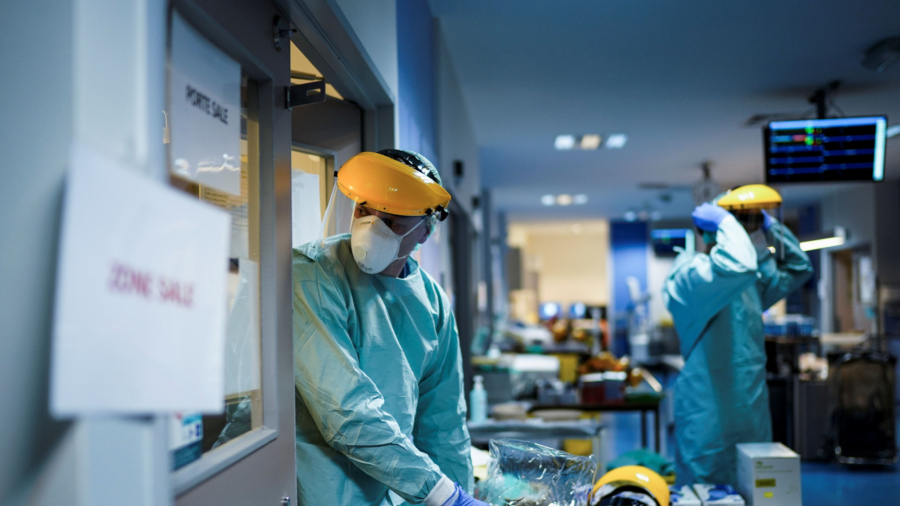
Belgium, based on its population of 11 million and geographical size of 30,500 square kilometers, is considered a small country among the 195 sovereign nations in the world.
Why is Belgium experiencing such a severe situation?
Belt and Road
Two of Belgium’s most important ports have embraced Beijing’s Belt and Road initiative (BRI, also known as One Belt, One Road), an ambitious project to build geopolitical influence by financing infrastructure projects throughout parts of Europe, Africa, and central and south Asia.Belgium’s geographical location is strategically advantageous. It faces the Netherlands in the north, France in the south, Luxembourg and Germany in the east, and the North Sea in the west.
Belgium’s largest port of Antwerp is close to the production and consumption center of Europe. Such a logistics hub was coveted by Beijing.
In July 2015, the Port of Antwerp set up a "Belt and Road" task force, signing a deal with Chinese companies to build a "China-Europe-Africa International Trade and Logistics Center."
The port authority of Antwerp then signed “twinning port” agreements or memorandums of understanding with ports in Shanghai, Shenzhen, Ningbo, Tianjin, Qingdao, and Dalian.
Meanwhile, the port training center at Antwerp has trained roughly 3,800 Chinese maritime experts.
The port of Zeebrugge, on the northern coast of Belgium, is the second most important commercial port in Belgium. It is close to Britain across the strait. Today, there are still ferry connections between Zeebrugge and the British ports of Hull and Dover.
Cooperation Between Chinese Investment and European Technology
The car factory Volvo Car Gent, located in the port district of Ghent in western Belgium, covers an area of more than 490,000 square meters. The largest Belgian car manufacturer was founded in 1965, and it was the first European Volvo plant outside Sweden. Ford Motor bought Volvo in 2009 for $6.45 billion. But Ford was in trouble during the global financial crisis in 2008, and began divesting assets. In 2010, Ford sold Volvo to China’s Geely Group for $1.8 billion, which became the first Chinese company to own a multinational premium car brand.With the increasing popularity of Volvo in the Chinese market, the brand's car output continues to reach new highs, and the Volvo car plant has gradually become the fulcrum for the global layout of Geely.
On May 30, a batch of Volvo S90 cars produced in Daqing was transported to the port of Zeebrugge in Belgium via the Asia-Europe Railway and transferred to Ghent. Soon after, a large number of new luxury Volvo cars that were made in China were distributed to the European market from the central auto plant in Ghent.
Geely spent $1.8 billion to buy Volvo. Can it compete in the targeted European market? Can they afford the world's most cutting-edge automotive production technology that is continuously upgraded? This was still very uncertain at the time. But now it seems that China already has what it wants. At the same time, the 100 percent Chinese-owned Swedish car brand has fully demonstrated the "Made in China" high-quality products in Europe and the world. This is precisely the influence that the Chinese regime wants to achieve in pushing forward its Belt and Road Initiative.
The Belgian auto industry that is seeking investment and business cooperation with China can be likened to the Chinese idiom: “pick a sesame seed only to lose a watermelon,” which means, concentrate on small gains at the expense of more important ones.
Key Politicians Advocate Belt and Road Initiative
Kris Peeters, Deputy Prime Minister and Minister of Economy and Employment of Belgium from 2014 to 2019, visited China many times. He stated on various occasions that Belgium is willing to team up with Beijing to contribute to the BRI.On March 23, 2017, the Asian Infrastructure Investment Bank (AIIB) approved 13 new members, including Belgium, bringing the total bank members to 70.
"In order to be successful, they must be developed together with all stakeholders, not only with national and regional governments and economic operators, but also with the local communities who will be most directly affected," he said.
On March 27, 2018, when Peeters attended a ceremony at Volvo’s factory in Ghent, he praised China’s Geely brand in Belgium, and criticized the Trump administration for increasing tariffs on Chinese products as “unwise” trade protectionism.
Similarly, former Belgian Prime Minister Yves Leterme is also an enthusiastic advocate of Belgium becoming a partner of China’s BRI.
Spreading the CCP's Propaganda
Beijing has opened six Confucius Institutes in Belgium so far. In addition, more than 50 schools in Belgium that offer Chinese language courses use textbooks provided by the CCP, which means, these are brainwashing materials compiled by the regime.In recent years, the two countries have more than 100 cultural exchange programs in music, art, and cultural performances every year. The Brussels Chinese Cultural Center, founded in 2015, is an active participant.
Virus Outbreak
According to an April 2 report by Xinhua, Xi Jinping had a phone conversation with King Philippe, in which the Belgian king said that China took the lead in putting the CCP virus outbreak under control, and its experience is of important value to other countries fighting the pandemic.“Noting China has been supporting and contributing to other countries' fight against the disease, King Philippe said Belgium appreciates China's provision of emergency medical protective supplies, and is willing to collaborate with China on drug development,” Xinhua wrote.
Xinhua is the official mouthpiece of the CCP. It is difficult for the outside world to verify whether King Philippe actually made such statements. Those words seem to parrot the CCP ’s narrative. However, his close relationship with the CCP is evident.
A Xinhua report quoted Xi as saying that China would “tighten up quality control measures, and provide as many resources as it can for the global fight against the disease.” What an irony.
Xi’s promise and the poor-quality masks sent to Belgium prove that the CCP is not trustworthy. Whoever believes in the CCP will be duped.
In Belgium, both the royal family and key politicians are advocating the BRI project. Its government was said to have placed the discussion of BRI cooperation high on the agenda.
Italy was the first G-7 country to join BRI, despite opposition from other EU leaders. It is one of the countries hardest-hit by the global pandemic. More than 25,000 Italians have died from the CCP virus so far. The outbreak in Belgium is just as serious. It is a warning for Belgium: stay far away from the CCP.