


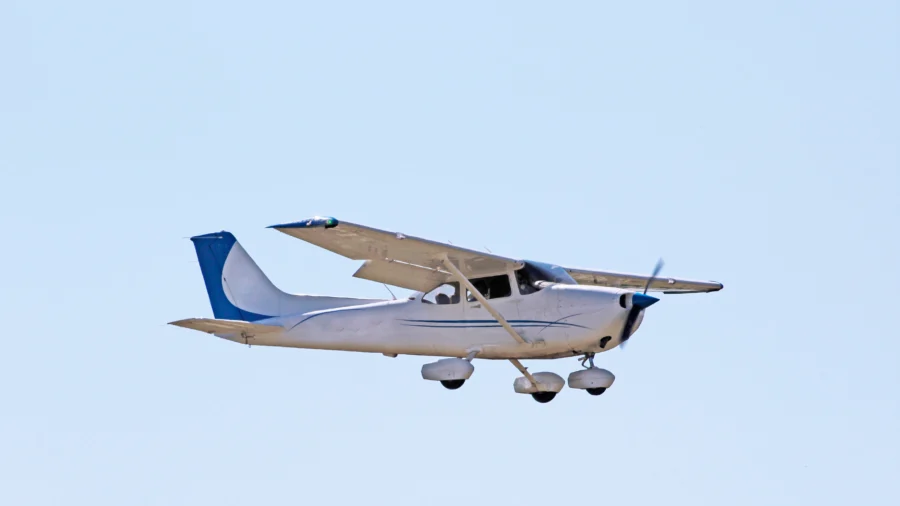
Two young pilots on an instructional flight are presumed dead after their small plane crashed into Lake Pontchartrain Monday night several miles short of New Orleans Lakefront Airport.
The crash prompted an intensive air and water search that stretched into Tuesday, authorities and the flight school’s owner said.
The flight was an instructional trip operated by Apollo Flight School, according to Carasto, who said the two pilots were in their mid-20s and were both working toward commercial licenses. The instructor, a woman, had logged about 1,300 hours in the air and was described by Carasto as a “highly qualified” instructor who was roughly 300 hours short of the experience needed to fly for an airline. The student, a man, was about 250 hours shy of the flight time required for his commercial license.
Because it was a training flight, either pilot could have been at the controls when the plane went down, Carasto said. He explained that switching control of the plane back and forth is common practice in instruction and said he did not want to guess who was flying when the plane went down.
Carasto said the Cessna was a late-1970s or early-1980s model, but it was maintained in compliance with regulatory standards. He added that he does not believe maintenance will be a factor in the crash.
He said the plane was descending toward Lakefront Airport and crashed roughly four miles from the runway. He said the impact was so severe that the aircraft “pretty much disintegrated” when it hit the water, and that only some parts of the plane, including a seat cushion, have been recovered so far.
Carasto said the flight took place at night in what he described as “marginal weather.” He said flying over water in the dark can be especially difficult because of the lack of a visible horizon, which can disorient pilots.
He explained that such conditions can cause vertigo for those at the controls, though he did not say he believed that was definitely a factor in this particular crash.
Carasto called the crash an “unbelievable tragedy” and a “huge loss.” He said that, in his 46 years as a flight instructor and pilot, this is the first incident he has ever experienced.
The tower received no distress call as the plane descended toward Lakefront Airport. Federal investigators with the Federal Aviation Administration and the National Transportation Safety Board are examining the crash.
Carasto said that “nobody knows what happened at this time” and that early information suggests “it was not mechanical.”
He said he believes search teams have narrowed down the crash area and that he is hopeful the plane will be found. “I have high hopes that they will be recovering the airplane. It is not going to be intact at all because the impact was very, very violent,” Carastro said.
The aircraft continued west over Louisiana and then tracked over Lake Pontchartrain, where it remained for about another 10 minutes. The plane then descended an additional 900 feet over the lake before vanishing from the airspace.
As of Tuesday afternoon, the pilots remained missing, multiple agencies were still searching the lake, and the cause of the crash was undetermined.