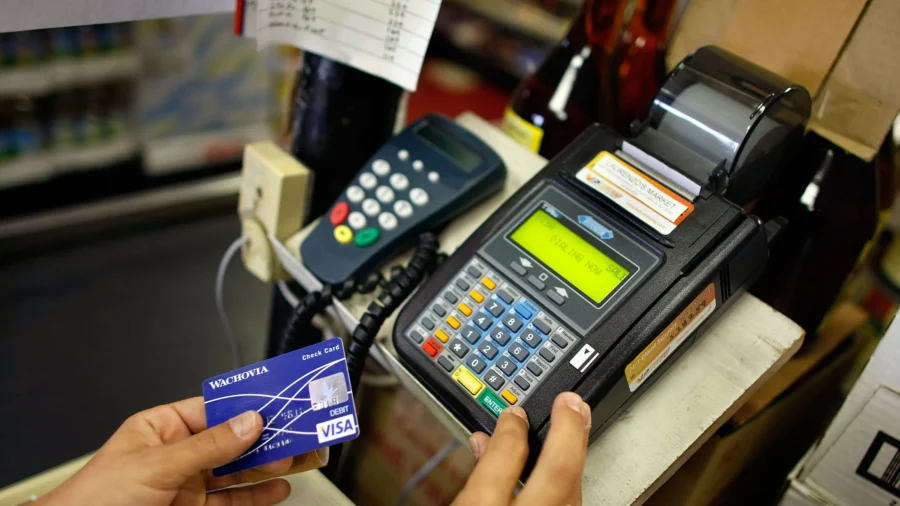
Most credit card holders don’t think twice about paying extra charges, in addition to interest, on their plastic. Yet maybe they should, as credit card surcharges continue to eat into cardholders' earnings.
According to LendingTree
data, 62 percent of cardholders have paid extra to use a credit card. Another 35 percent say they weren’t aware of extra card charges after being hit with the fees.
“When consumers see 'extra fees' at checkout, they often assume it’s a shady tactic, but many of these surcharges are embedded in merchant practices and permissible, depending on state laws,” Linda Jensen, a certified financial planner at Heart Financial Group in Olympia, Washington, told NTD. “Many consumers don’t realize that what looks like a ‘processing’ or ‘service’ charge is in fact a credit card surcharge, something merchants are legally allowed (in many states) to pass along to you.”
3 Main Types of Credit Card Fees
The LendingTree study concluded that about half of all cardholders are unaware that card companies generate revenue from swipe fees, despite being charged for using their cards. The first step is to know you’re being charged extra by your car provider—identify what the fee is and how much it costs, then take steps to mitigate it, if possible.1. Swipe fees, also known as interchange fees, are the fees that merchants pay to accept credit cards. When merchants tack on a credit card surcharge, they’re typically doing so to cover these fees. However, 46 percent of cardholders don’t realize that card companies make money off these fees or that card providers have limits on swipe fee charges.
“While these surcharges are legal in most states, some rules must be followed,” the Lending Tree report noted. “The rules are set by the card networks (think Visa, Mastercard, and Discover, among others.”)
While fee restrictions may vary among credit card networks, there are two key rules that card providers must adhere to, LendingTree noted:
- The surcharge can’t exceed your credit card processing costs. In other words, you can’t make a profit with these extra fees.
- Card companies need to tell the consumer in advance.
“Merchant card processing costs usually run 1.5 percent–3.5 percent of a transaction,” Jensen noted. “Many pass on 2 percent–4 percent to consumers, capped at 4 percent under card network rules.”
On a $100 purchase, the surcharge fee might add $1.50–$4.00. “While modest for small purchases, these extras add up quickly on big-ticket items or frequent use," she added.
2. Convenience fee is a separate fee for using a nonstandard payment channel, such as online or phone. “It’s often hidden in 'service' language,” Jensen said.
3. Minimum purchase fee, also called credit minimums, is a fee that establishes baseline requirements for spending a set amount (e.g., $5–$10) when using a card. “Other add-ons may include cross-border/currency conversion markups, or 'drip pricing' where fees appear only late in checkout,” Jensen said.
Steps to Alleviate Extra Credit Card Fees
As the Lending Tree study noted, U.S. businesses in most states have the right to add a surcharge when you buy with a credit card, but it doesn’t mean cardholders can’t fight back.1. Avoid using the card, except for essential purchases. Consumers are free to use alternative payment options, such as debit cards, cash, and, in a growing number of cases, cryptocurrencies. “If one of them charges a surcharge, consider leaving that place and seeking another that doesn’t,” Lending Tree advised.
2. Know the limits of a surcharge. Cardholders should make it their business to understand where card surcharges are legal, where they’re not, and what the maximum surcharge limit is.
“Generally, care surcharges are around 3%, so anything more than that rate you should be wary about,” Branden Korf, a marketing specialist at EBizCharge in Irvine, California, told NTD. “As far as where card surcharges are legal and not legal, the laws are actively changing, so do your research.”
3. Ask to waive the fee. Often, merchants waive fees for loyal customers or large purchases. “Also, use your card strategically,” Jensen advised. “If card rewards outweigh the fee, paying the surcharge may still be worth it.”
The views and opinions expressed are those of the interviewees. They are meant for general informational purposes only and should not be construed or interpreted as a recommendation or solicitation. NTD does not provide investment, tax, legal, financial planning, estate planning, or any other personal finance advice. NTD holds no liability for the accuracy or timeliness of the information provided.