


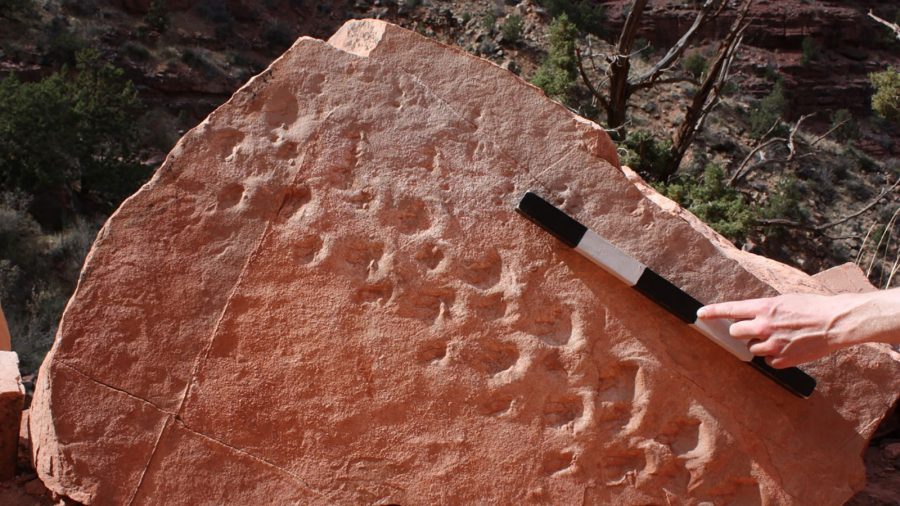
Finding fossil footprints at the Grand Canyon isn't particularly unusual. The expansive stretch of red rock is home to an array of formations containing preserved remains of the past.
But a discovery made by a geology professor turned out to be a bigger deal than he could have imagined: what he stumbled upon were the oldest vertebrate fossil tracks ever found at Grand Canyon National Park—about 313 million years old.
Geologist Allan Krill, a visiting professor from Norway at the University of Nevada, Las Vegas (UNLV), came across a boulder marked with set of fossil footprints while on a hike with students in 2016, according to a news release this week from the park.
Intrigued by his finding, Krill sent a photo of the tracks to colleague Stephen Rowland, a paleontologist at UNLV. Rowland and a team of colleagues documented the discovery in a paper published Wednesday in the journal PLOS One.
"These are by far the oldest vertebrate tracks in Grand Canyon, which is known for its abundant fossil tracks," Rowland said in a statement." They are among the oldest tracks on Earth of shelled-egg-laying animals, such as reptiles, and the earliest evidence of vertebrate animals walking in sand dunes."
The boulder containing the fossil tracks was exposed after a cliff collapsed. It had been in plain sight alongside a trail, but had seemingly gone unnoticed until Krill brought it to the attention of geologists.
Researchers said the footprints show two separate animals passing on the slope of a sand dune.
The pattern of the footprints revealed a distinctive gait that scientists did not know about in early animals. Called a lateral-sequence walk, it involves the rear leg and the front leg on one side of the animal moving together, alternating with those legs on the other side moving together.