


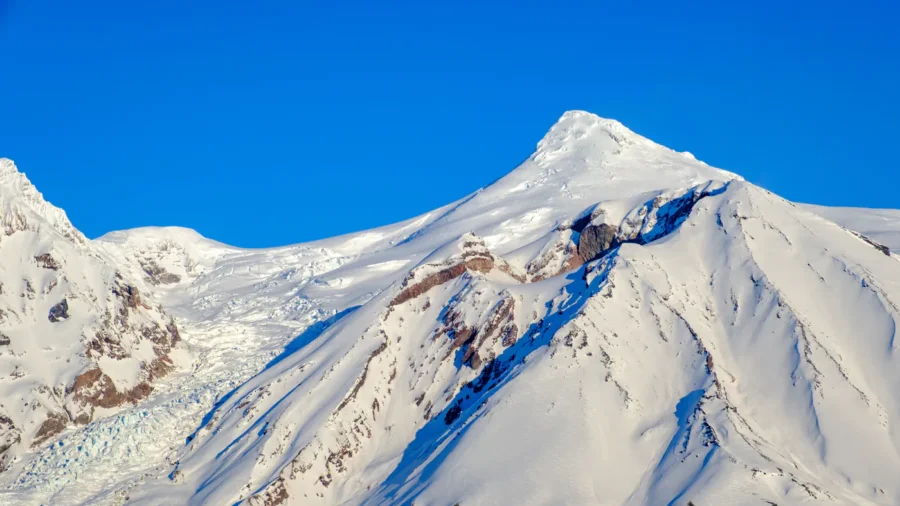
Geologists say there is a 50 percent chance that a volcanic eruption may be immanent at Alaska’s Mount Spurr, located 75 miles west of Anchorage, the state’s largest city.
According to the Alaska Volcano Observatory (AVO), the 11,000-foot snow-covered volcano has been showing increasing seismic activity over the past 10 months.
The seismic activity began in April 2024, when each week 30 small earthquakes were recorded on average, the AVO said. This persisted until early October, when the rate of earthquakes increased to 125 per week—amounting to roughly 2,700 earthquakes thus far.
The largest of these earthquakes, which occurred on Jan. 2, 2025, had a magnitude of 2.9.
Scientists have also observed surface deformation of the volcano’s flanks, indicating that fresh magma has been pressed into the crust beneath the volcano.
The AVO considers it “equally likely” that there will be either a “failed” eruption—a significant earthquake with ground deformation but without any actual eruption—or an eruption of the Crater Peak vent, located two miles south of the volcano’s summit.
This eruption will likely consist one or more explosions that spew ash and debris into the air, possibly accompanied by pyroclastic flows—hot gas and volcanic mud running down the mountain flanks.
Ash clouds produced by such an event may be carried downwind for hundreds of miles. This could disrupt aviation and cause ashfalls over populated areas, including Anchorage.
A more severe scenario—eruption of the summit with magma flowing to the surface—is considered less likely, the AVO said. Geologists estimate such an event last occurred more than 5,000 years ago.
The observatory did not make any predictions regarding the time of eruption—it could be days, weeks, or months, or the seismic activity may simply subside.
Either way, there would be increased activity leading up to the eruption, like a further increase in earthquakes, sustained seismic tremors, increased gas emissions, more surface deformation, and melting snow and glaciers, the AVO said.
Mount Spurr, the largest volcano in the Aleutian Arc of Alaska, is monitored closely using various technologies, including a local seismic network, ground deformation detection, infrasound sensors, and a webcam, while satellites measure gas and ash emissions.
As far as recorded history goes, Mount Spurr erupted once in 1953 and three times in 1992, in both instances this occurred at the Crater Peak vent.
These were brief, explosive eruptions that produced ash columns that rose up to 65,000 feet above sea level.
The 1992 eruption lasted for about 4 hours and caught geologists by surprise—a massive ash cloud shut down Ted Stevens Anchorage International Airport for 20 hours and darkened the sky over Anchorage, leaving an ash deposit about an eighth of an inch thick all over the city and the wider regions of south-central Alaska.
It wasn’t the first time Anchorage was covered in ash; Mount Redoubt, another volcano just south of Mt. Spurr, did so during a series of eruptions in 1989 and 1990.