News Analysis
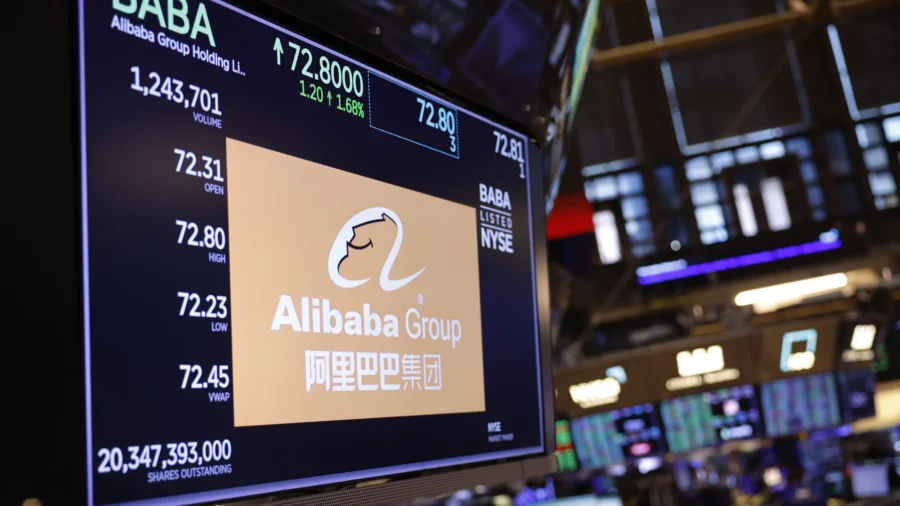
Are Alibaba’s days on the U.S. stock exchange numbered? They might be.
The House Select Committee on the Chinese Communist Party said on Nov. 17 that it wants to delist Alibaba from the Nasdaq and make it harder overall for U.S. investors to put money to work in China.
The White House
says Alibaba is a Chinese defense contractor, something the e-commerce and cloud services giant calls “complete nonsense.”
“Wherever a Chinese company or a Chinese national is, throughout the world, is required to carry out the mission of the Chinese Communist Party,”
said House Select Committee Chairman John Moolenaar (R-Mich.) during a recent episode of “Securing America” hosted by Frank Gaffney. “That means when customer data or different information on cloud services, different vulnerabilities and cybersecurity, if those exist and Alibaba is aware of those, they are required to hand that information over to the Chinese Communist Party. So, it creates a situation where you don’t want Alibaba in our infrastructure in any way.”
This is not the first time Moolenaar has called for Alibaba’s delisting. He has been on the offensive since the White House memo on the company was covered in an exclusive
Financial Times article on Nov. 14.
“The federal government and industry must take steps to protect the American people and eliminate Chinese companies’ access to our markets and innovation,” Moolenaar told the FT.
Alibaba and the White House did not respond at press time.
One of the Trump administration’s first statements regarding how the White House will regard China was published back in February. The America First Investment Policy
said China should not be invested in critical infrastructure in the United States. It also set the tone for new China business and investor risks.
The America First Investment Policy said new rules would be established to “stop United States companies and investors from investing” in Chinese defense contractors. This includes companies that would be like the equivalent of Boeing in the United States. Boeing makes commercial airplanes, but it also makes the F-15 Eagle fighter jet through its defense subsidiary Boeing Defense, Space & Security.
Of particular interest to Alibaba, however, is the policy’s statement on reviewing the variable interest entity (VIE) and subsidiary structures used by many Chinese companies to trade on U.S. stock exchanges. Alibaba is set up as a VIE, which means investors really own a holding company that has a piece of Alibaba as opposed to actually owning shares of Alibaba.
These risks are hitting Chinese companies in all sorts of sectors, including EV battery maker Gotion High-Tech.
In October 2025, Michigan terminated its support for building an EV battery plant. Gotion likely put that project on hold due to
growing geopolitical risks, even during the Biden era, and local protests against it. Michigan is now trying to
recoup roughly $23.7 million it disbursed to Gotion to build the factory.
Despite Gotion not being a state-owned enterprise, or having any defense ties, opposition came from people who said taxpayer money should not be going to support a rival country that already dominates an economic sector. Chinese companies are the largest EV battery makers in the world, led by Contemporary Amperex Technology Company (CATL).
A Man Alone?
When it comes to the America First Investment Policy as it relates to China, Moolenaar risks becoming a lone wolf. In April, he sent a letter to the CEOs of the
Bank of America and
JPMorgan demanding they withdraw from underwriting CATL’s initial public offering on the Hong Kong Stock Exchange in May. He cited the fact that the Department of Defense–now called the Department of War–designated CATL as a “Chinese military company” under Section
1260H of the National Defense Authorization Act.Both banks continued as underwriters. As did Goldman Sachs and Morgan Stanley.
U.S. fund managers like Ballie Gifford and BlackRock’s iShares exchange-traded funds have more than a million shares in CATL combined.
Some companies that are sanctioned by the U.S. government also still count on U.S. capital. Sanctions do not always ban American investors from owning shares. For example, Hoshine Silicon Industries, makers of materials used in solar and semiconductor production, is on the
Uyghur Forced Labor Entity List. But Vanguard, State Street Bank, and BlackRock still have these shares in mutual funds and exchange-traded funds that common retail investors own, based on
Morningstar data.
In 2018, the Biden administration
issued a ban on the purchase and use of all commercial off-the-shelf drones for the Pentagon. The following year, Congress passed legislation specifically banning China’s DJI drone maker from government contracts. As of October,
DJI is still trying to get that ban lifted by a court. Consumers, however, can still buy
DJI drones on Amazon. DJI is privately held.
Recent partnerships between leading Wall Street firms and Chinese state banks undermine the integrity of the United States' financial services industry. Whether structured as joint ventures or wholly-owned subsidiaries, these entities operate under Chinese law, subjecting them to the regulatory control of the CCP. This power imbalance gives Beijing influence within Wall Street institutions, getting free lobbying on their behalf on Capitol Hill, members of the House Select Committee have said since the Committee’s founding in 2023.
Wall Street Watched, But Venture Capital, Private Equity Still Exempt
Restricting Wall Street is usually the main target. Both the Biden and Trump administrations did this in their first terms, banning investment into dozens of Chinese defense contractors listed on the Shanghai and Shenzhen stock exchanges.But few ever talk about the money Chinese companies get from corporations, let alone Silicon Valley venture capital invested in Chinese start-ups.
Rep. Maxine Waters (D-Calif.) has talked about this since 2023, but no changes have been made.
“We should not give a pass to investments that Wall Street private equity and Silicon Valley venture capitalists have already made in China-based companies,” she
warned in 2023. “The rules should appropriately require divestment or revocation of existing investment agreements.”
Waters's comments likely worried private investors. By 2024, she was more nuanced and said in Finance Committee hearings that she did not want to hamper all investments in China. “These rules should be based on facts and we should have good information about what kind of investments we will be restricted,” she
said in a February 2024 hearing.
Still, Washington has signaled that it wants both Wall Street and private capital to think twice about China.
Recent data show private investment in Chinese companies plunged in the 2023–2024 period. In 2023, U.S.-backed funding rounds in China totaled only about $3.9 billion (across 116 deals), roughly half the 2022 total,
according to S&P Global. Through mid‑2024, the decline accelerated—just $650 million was invested in 45 deals in the first half of last year, down 88.9 percent annualized.
Overall, U.S. investors are focusing on non-threatening consumer and health care targets while technology-sector deals face high risk.
The Treasury Department is
still reviewing a Benchmark Capital-led $75 million investment in Chinese startup Manus AI. Silicon Valley-based Benchmark was the lead investor in a Manus AI funding round last November. The deal has only recently been put under a microscope because of concerns on Capitol Hill that China is now a near-peer competitor to the United States in artificial intelligence. Elected officials like Moolenaar of the House Select Committee believe China has come this far thanks to U.S. tech companies and investors.