


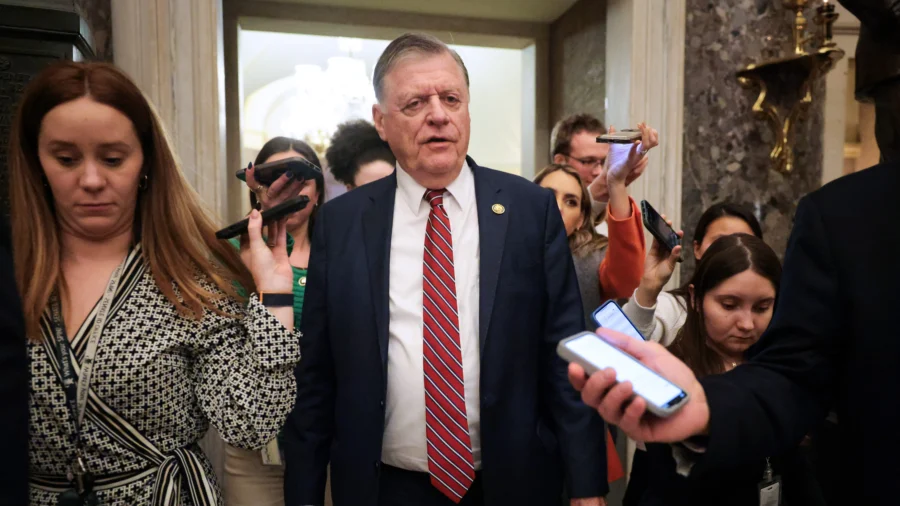
A bipartisan, bicameral agreement on health care spending announced on Jan. 19 includes one element of President Donald Trump’s recently announced Great Healthcare Plan, but makes no mention of the Affordable Care Act’s enhanced premium tax credits.
The agreement provides $116.6 billion to the Department of Health and Human Services, which Rep. Tom Cole (R-Okla.) said champions the administration’s Make America Health Again priorities.
The health spending is part of a $1.2 trillion government funding package that also covers the Departments of Labor, Education, Defense, Transportation, and Housing and Urban Development, and related agencies.
Provisions of the agreement include increased funding for mental health and substance abuse treatment and prevention; $418 million in spending for rural health, including for rural hospitals, especially those at risk of closure; $1.9 billion for community health centers in underserved communities; and $1.2 billion for maternal and child health programs.
The spending allowance also designates $1.4 billion to combat the shortage of health care workers in rural communities and other underserved areas.
Sen. Bernie Sanders (I-Vt.) said the agreement did not go far enough in addressing problems in the health care system, but endorsed it nonetheless.
“Given the extremely dysfunctional political environment in Congress, I am proud that we were able to reach a bipartisan health care deal to begin to provide meaningful relief to the American people on all of these major crises,” Sanders said in a Jan. 20 statement.
Rep. Rosa De Lauro (D-Conn.), ranking member of the House Appropriations Committee, said the bipartisan agreement counteracts Trump administration efforts to cut spending in some areas.
“Where the White House attempted to eliminate entire programs, we chose to increase their funding,” De Lauro said in a Jan. 20 statement, noting the increased funding for the National Institutes of Health.
The bill requires greater transparency in drug pricing through mandated reports to insurers and the pass-through to the customer of 100 percent of rebates obtained from drug manufacturers.
Trump has also asked Congress to consider codifying other parts of his health care plan into law.
Those include the Most-Favored-Nation Prescription Drug Pricing policy, making health subsidies directly available to consumers rather than providing them to insurance companies, and requiring insurers and care providers to publish their prices to the public in plain language.
A White House spokesperson said on Jan. 15 that legislative action was expected, but no bills had been drafted.
Separately, bipartisan lawmakers in both houses of Congress are working on an agreement to extend the expired enhanced subsidies for Obamacare customers, though no specific plan has been announced.
Democrats have widely supported extending the COVID-19 era subsidies due to the rapidly rising cost of health insurance.
House Speaker Mike Johnson (R-La.) had been adamant that the appropriations process be completed through full consideration of the 12 required appropriations bills rather than by passing a single, omnibus spending bill.
If passed by the House, this four-bill package would complete that process on the House side.
The Senate has passed five bills, four of which have been signed by the president.
A House vote on the Consolidated Appropriations Act of 2026 is expected this week.