

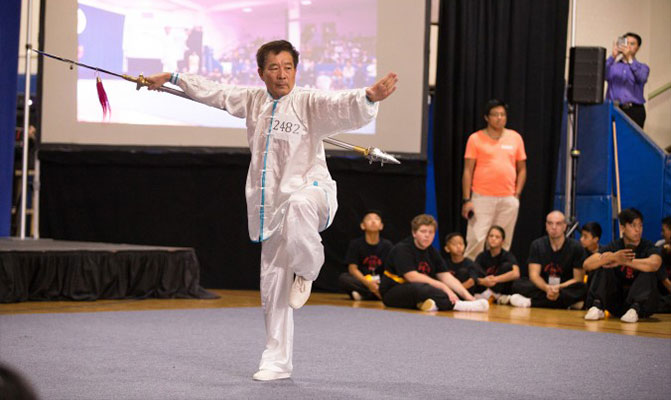
At 90, Chao Fu-lin of Taiwan isn’t quite what he used to be, but his skills with the various weapons and methods of ancient Chinese martial arts remain impressive. On a recent weekend at a gymnasium in upstate New York, he moved agilely and gracefully across the floor to a crowd of fans—on the surface partaking in an international competition, but in essence joining a movement to reinvigorate the semi-mystical heart of Chinese kungfu.
From Sept. 17 to Sept. 18 the Chinese-language broadcaster New Tang Dynasty Television (NTD), based in New York, held its fifth International Chinese Traditional Martial Arts Competition in Middletown, a city of 25,000 two hours from Manhattan.
Drawing male and female contestants from eight countries and across 80 years of age, the competition seeks to encourage authentic martial arts, known as “wushu” in Chinese. Contestants performed in armed and unarmed groups, as well as individual or pair demonstrations.
For the wispy sideburn-sporting Chao, who lives in Taiwan but was born in central China at a time when warlords reigned supreme, the event came as an honorable and possibly final opportunity.
Martial Virtue
As a people venerating order and refinement, the ancient Chinese paid attention to virtue and morality—even in combat. Men strove to be “skilled in both the civil and the martial,” a term so regarded that it evokes the image of stately advisers and officers at the imperial court. In the opening lines of the “Art of War,” strategist Sun Tzu states that victory goes to the army whose commander more thoroughly grasps the Tao, or Way.
Central to the Middletown competition’s philosophy is the concept of martial virtue, known as “wu de” in Chinese. This taps the spiritual marrow of traditional martial arts, used only to defend against injustice, and not for aggression.
“This competition is unlike any competition for profit,” said Wu Cheng-han, a Taiwanese contestant and practitioner of the Eight Extremities Fist style. “It is about respect, respect for what is greater than all of us. And this is the spirit of Heaven. This is similar to how martial artists bow, how they show humility and respect to their grandmasters, Buddhas, and Heaven.”
Chin Li-yen, who has served as the bodyguard for four presidents of Taiwan, is also a master of Eight Extremities Fist method of northern Chinese wushu. This school was originally a secret method practiced by imperial guards in the Qing Dynasty, and contains a wide range of lethal moves.
Given this, morality is paramount, Chin told NTD. “Winning lands you in court; losing gets you in the hospital,” he said. “So it can’t be about winning or losing.”
Gold prizes at the competition included five swords specially forged for and donated to the event by famous Taiwanese master Ch’en Chong-chih. The five gold prize winners, decided by a board of judges, also received $5,000 each.
Lost Traditions
“Traditional Chinese wushu has been passed down for a few thousand years,” said Li Youfu, head judge at the competition. According to this renowned master from Beijing, the rich inner meaning and history of wushu lend themselves to faith in divine principles.
“As for its earliest roots, there’s the saying: divinely-imparted culture,” he told NTD.