

President Donald Trump on May 14 began a two-day summit in Beijing with Chinese leader Xi Jinping amid significant tensions between the two countries.
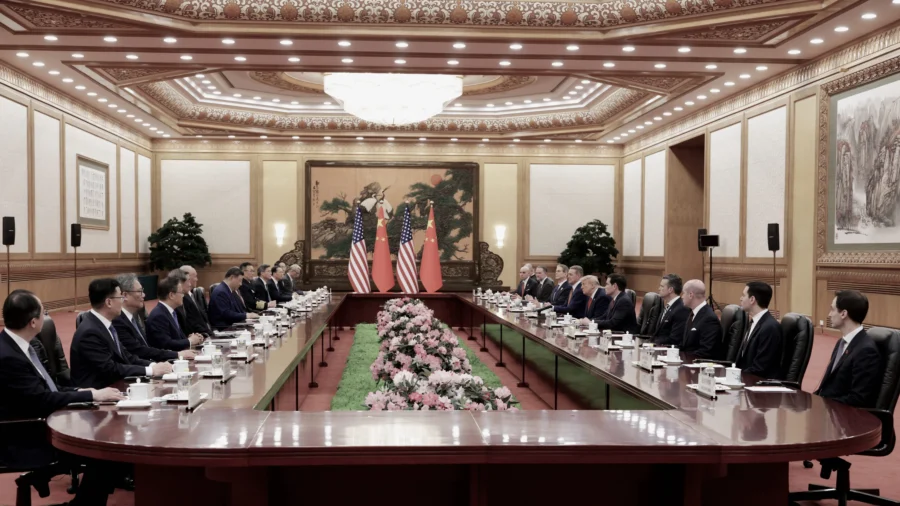
Trump and Xi first attended a welcome ceremony near Tiananmen Square, followed by a bilateral meeting at the Great Hall of the People. The ongoing trade tensions are expected to dominate discussions between the two leaders.
At the start of the meeting, Trump praised the welcome ceremony, especially the children who participated.
Trump and Xi, along with their delegations, were seated around a large table, facing each other. Secretary of State Marco Rubio sat to Trump’s left, and U.S. Ambassador to China David Perdue to his right.
Trump praised the U.S. business delegation, calling the company executives who joined the trip “the best in the world.”
“They look forward to trade and doing business, and it's going to be totally reciprocal on our behalf,” Trump said. “I really look very much forward to our discussion.”
Speaking at the meeting, Xi expressed hope that 2026 will mark the beginning of “a new chapter in China-U.S. relations.”
After the opening remarks, the press was quickly asked to leave and didn’t have a chance to ask the leaders questions.
During the two-day summit, the U.S. delegation is hoping to secure new agreements and purchase commitments from China in aerospace, agriculture, and energy.
“The American people can expect the president to deliver more good deals on behalf of our country,” White House spokesperson Anna Kelly told reporters during a call on May 10.
Iran Conflict
The Beijing summit is being held against the backdrop of the ongoing conflict in the Middle East, which shows little sign of reaching a resolution soon.Washington has criticized China for its close ties with Iran. China is Iran's biggest oil buyer, main trading partner, and a long-time ally. The Trump administration has urged the Chinese regime to support U.S. efforts to keep open the Strait of Hormuz, a key international oil transit corridor that the Iranian regime has effectively blocked.
Although Trump has repeatedly urged Beijing to pressure Tehran, this is not Washington's primary concern, officials said. The main worry, as with Russia, is that China provides support to Iran through oil revenue and possibly by supplying weapons.
The president has spoken multiple times with Xi about Iran and Russia, including the revenue China provides to both regimes, a senior administration official told reporters during a call on Sunday. The talks involved “goods, components, parts,” as well as “potential of weapons exports.”
“I expect that conversation to continue,” the official said.
Before leaving for Beijing, Trump compared the Iran ceasefire to a patient with the slimmest chance of survival.
“I would call it the weakest right now, after reading a piece of garbage,” Trump said, referring to the latest proposal sent by Tehran. "I didn't even finish reading it."
“I would say the ceasefire is on massive life support.”
Changing Rubio's Name
A key moment at the summit was Rubio’s first in-person meeting with the CCP officials who had sanctioned him in 2020. Rubio was targeted by Beijing because of his long-standing criticism of the Chinese regime.After Rubio became Secretary of State, officials in Beijing quietly changed a Chinese character in his name to give the impression that sanctions targeted a different “Rubio,” not the current U.S. secretary of state.
In 2024, Rubio introduced a bill aimed at deterring the Chinese regime’s state-sanctioned killing of Falun Gong practitioners for their organs.
On May 5, at a White House press conference, Rubio said that human rights violations, including forced organ harvesting, remain important priorities for the administration.
“We always raise those issues, and they remain true,” Rubio said in response to a question from NTD, a sister media outlet of The Epoch Times. “They’re important to us, among others, of course, but those issues remain prominent in our view and in our conversation about these things, and we’ll continue to raise them in the appropriate forums.”
On May 11, Trump told reporters that he planned to discuss with Xi the cases of imprisoned media entrepreneur Jimmy Lai and pastor Ezra Jin Mingri.
Others who accompanied Trump on this trip include his son Eric Trump, daughter-in-law Lara Trump, Defense Secretary Pete Hegseth, and U.S. Trade Representative Jamieson Greer.