

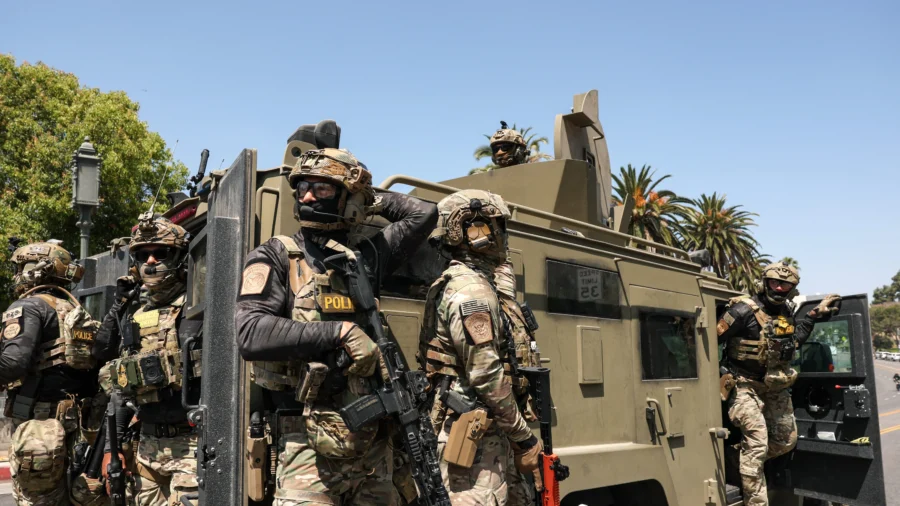
The new law, SB-627, forbids any law enforcement officer or agent from wearing facial coverings that hide their identity during official operations, according to the bill text. The measure includes criminal penalties for violations and applies to federal, state, and local personnel operating throughout California.
Newsom announced the signing at a Los Angeles news conference, which was attended by state lawmakers, education leaders, and immigrant community members. The Democratic governor said the legislation is in response to recent immigration raids where federal agents wore masks while making arresting many.
"We celebrate that diversity. It's what makes California great. It's what makes America great. It is under assault," Newsom said, referring to California's foreign-born population of 27 percent.
The governor criticized the practice of masked agents without identification or badge numbers detaining people on streets.
"The impact of these policies all across this city, our state and nation are terrifying," Newsom said. "It's like a dystopian sci-fi movie. Unmarked cars, people in masks, people quite literally disappearing. No due process, no rights, no right in a democracy where we have rights."
The legislation establishes both criminal and civil penalties for violations. Officers who break the new mask law face either fines or criminal misdemeanor charges. The law also removes qualified immunity protection for officers who commit assault, battery, false imprisonment, false arrest, abuse of process, or malicious prosecution while wearing masks, establishing a minimum $10,000 penalty for liable violations.
However, uncertainty surrounds the state's ability to enforce the ban against federal agents. Bill Essayli, acting U.S. attorney for Southern California, stated on social media that the federal government lacks state jurisdiction and informed agencies the mask ban does not affect their operations.
The new law includes several exceptions to the mask law. Officers may wear motorcycle helmets, facial coverings for SWAT operations, N-95 medical masks for COVID-19 protection, undercover agent disguises and tactical gear. The ban does not apply to state police.
The legislation prohibits neck gaiters, ski masks, and other facial coverings for local and federal officers, including immigration enforcement agents, during official business.
Trump administration officials defended the usage of masks, citing concerns for agents safety. Immigration and Customs Enforcement explained on its website that officers wear masks to prevent doxing, which has placed agents and families at risk.
"ICE law enforcement officers wear masks to prevent doxing, which can (and has) placed them and their families at risk. All ICE law enforcement officers carry badges and credentials and will identify themselves when required for public safety or legal necessity," ICE stated.
Tricia McLaughlin, Homeland Security assistant secretary for public affairs, called the legislation "despicable and a flagrant attempt to endanger our officers.”
"While our federal law enforcement officers are being assaulted by rioters and having rocks and Molotov cocktails thrown at them, a sanctuary politician is trying to outlaw officers wearing masks to protect themselves from being doxxed and targeted by known and suspected terrorist sympathizers," McLaughlin said.
State Sen. Scott Wiener, the bill's Democratic sponsor, criticized federal enforcement practices in strong terms.
"The ICE masked secret police are raining terror on communities across California, and it has to stop. Law enforcement should never be easily confused with the guy in the ski mask robbing a liquor store, yet that's what's happening with ICE's extreme masking behavior," Wiener wrote. "They should be proud to show their faces and provide identifying information in the course of duty."
The California Senate approved the bill by a two-thirds majority, while the Assembly passed it by simple majority.
Legal experts debate the measure's constitutionality. The Supreme Court previously ruled in Arizona v. United States that states cannot regulate federal immigration law enforcement. However, the California bill does not specifically mention immigration and appears to cover all law enforcement activities.
Constitutional law expert Erwin Chemerinsky at UC Berkeley defended the legislation, writing that federal employees must follow general state rules unless compliance would significantly interfere with their duties.
Newsom simultaneously signed companion legislation preventing immigration agents from entering schools and healthcare facilities without valid warrants or judicial orders. The measure requires schools to notify parents and teachers when agents appear on campus.
"Students cannot learn if they live in fear of being deported. The California Safe Haven Schools Act is a clear message to Donald Trump: 'keep ICE out of our schools,'" Assemblymember Al Muratsuchi said.
The Legislature previously authorized $50 million for the state Department of Justice and legal groups, resulting in more than 40 lawsuits against the Trump administration.