


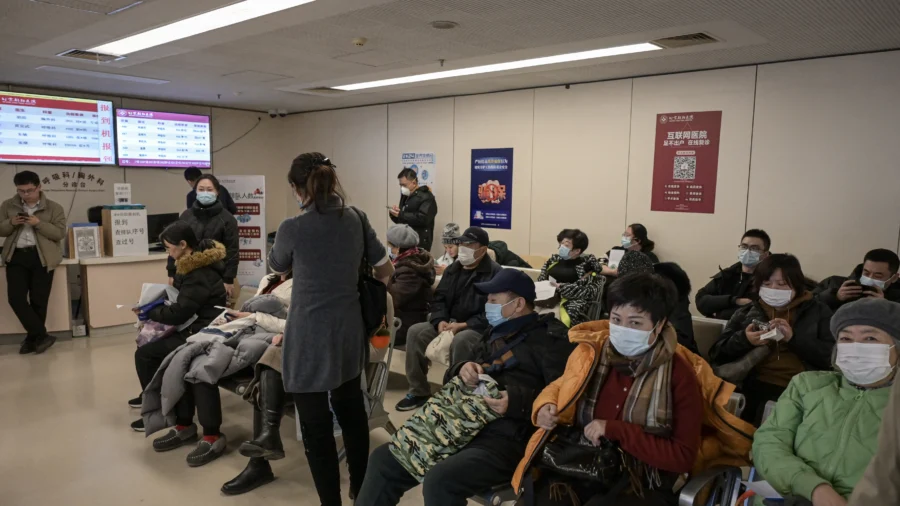
A new wave of outbreaks has overwhelmed China’s healthcare and funeral systems. The Epoch Times, NTD's sister media, has learned that hospitals and crematoriums in several regions have been operating at full capacity amid a surge in sudden deaths since mid-February.
In Hebei, a province in northern China, coffins have sold out and prices have surged. Meanwhile, in rural areas of eastern China's Anhui and northwestern China's Shaanxi, new graves are emerging in mountain villages, some of which have almost become ghost towns.
Mr. Hua, a villager from Tangshan, Hebei, said hospitals are overcrowded, comparing them to bustling marketplaces, while crematoriums struggle to handle the influx of bodies. He said many people in his hometown have passed away and securing a cremation now requires connections.
“It feels like the end of the world,” he said, noting that the deceased include both elderly and young people.
Hua said a relative had died from COVID-19 but added, "The government controls the media and doesn't let people talk about it."
Hillside Graves in Rural Ankang
A local villager from Shijiazhuang, Hebei, reported that the increasing number of deaths in the area has caused a shortage of coffins and a spike in prices.He described the price hike: "A coffin that used to cost around 4,000 yuan [$550] is now priced at 12,000 yuan [$1,653]."
Mr. Yao, a resident of Shijiazhuang, said the symptoms are quite serious, and some of his acquaintances have recently passed away. He noted that the streets are now empty and quiet.
“There are not many people in the countryside, there are not many people in the city. It feels like there are definitely fewer people,” Yao said. “There are no traffic jams when driving."
Mr. Zhang, a local villager from Ankang City in Shaanxi province, describes a rise in respiratory illnesses, particularly among children, and an increase in deaths among the elderly. Zhang said many children have been experiencing persistent coughs and severe diarrhea, with symptoms proving resistant to treatment.
“The cough lasts a long time, and neither medication nor injections seem to help,” he said.
Doctors, he noted, typically diagnose cases as severe colds without testing for specific viruses. Hospital visits often result in routine X-rays and common cold treatments, with some patients receiving anti-inflammatory medication.
According to Zhang, many people in his area have suffered repeated infections, with some cases developing into serious illness and, in several instances, death. He observed that sudden fatalities have been particularly common among older adults who are in their 60s and 70s. He added that other people developed severe colds with chills and fever but were not taken to hospitals for testing, especially during the Chinese New Year holiday.
“Between the 26th day of the last lunar month and the 10th day of the new year, 11 elderly people in our area passed away,” Zhang said while adding that the increase in deaths has left visible marks on the rural landscape.
He also observed new graves appearing across farmland and mountain valleys. Unlike urban residents, who are more likely to be cremated, rural villagers tend to follow traditional burial customs.
“Now, there are graves everywhere,” he said, describing fresh burial sites scattered throughout fields and hillsides.
Coffin Factories Rise, Official Burial Rules Eased
Chen, a worker at a coffin factory in Zhejiang Province, said the local epidemic has led to a rise in sudden deaths among younger people. "Many of my classmates in their 40s have passed away," he said.Chen added, “While other businesses are cutting jobs, we’re working overtime and hiring. In the past two years, seven or eight new coffin factories have opened here. We ship coffins nationwide, but now we’re running low on wood. Many of us even worked through the Chinese New Year.”
Li, a resident of Zhumadian in Henan Province, said that since the Chinese New Year, dozens of people within his social circle—including relatives, clients, and colleagues—have died.
In response to the rising death toll, crematoriums in several regions have reportedly added furnaces. Meanwhile, local officials in Henan and other populous provinces, including Anhui and Jiangxi, have eased enforcement of cremation policies, allowing more traditional burials in rural areas.
Previously, authorities strictly required cremation, even exhuming bodies for compliance. “However, these rules now appear to be loosely enforced, helping to relieve pressure on funeral services,” Li stated.
Chinese media reported an increase in deaths of young adults and middle-aged individuals during the Chinese New Year period.
41-year-old Wu Yuyan, deputy director of China New Weekly, died on Feb. 15. Actor Gao Liang passed away on Feb. 11 at 50. Shi Zhaojun, a lecturer at China Jiliang University, died on Feb. 8 at 32. Yi singer Mi Wanhong died on Jan. 31 at 38. Actor Liang Youcheng died suddenly on Jan. 30 at 27, while crosstalk comedy performer Xu Zhaocheng passed away on Jan. 16 at 36.
Many parents have also shared on social media that their young children died after contracting the flu.
Wen Xin and Xiong Bin contributed to this report.