


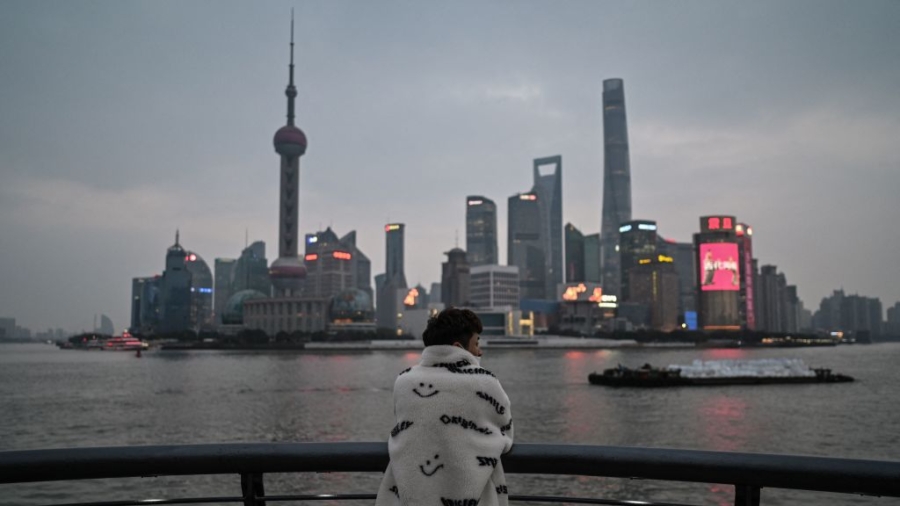
Despite censorship, the “garbage time of history” theme seems to live on in China. It suggests a fracturing in the upward mobility promise the Communist Party counted on to maintain power.
“Trump’s trade war has exacerbated the situation,” Gordon Chang, a well-known China hawk, told NTD. “But the trade war is sort of like a current event. The real problem is that the CCP has policies that are worsening China’s problems.”
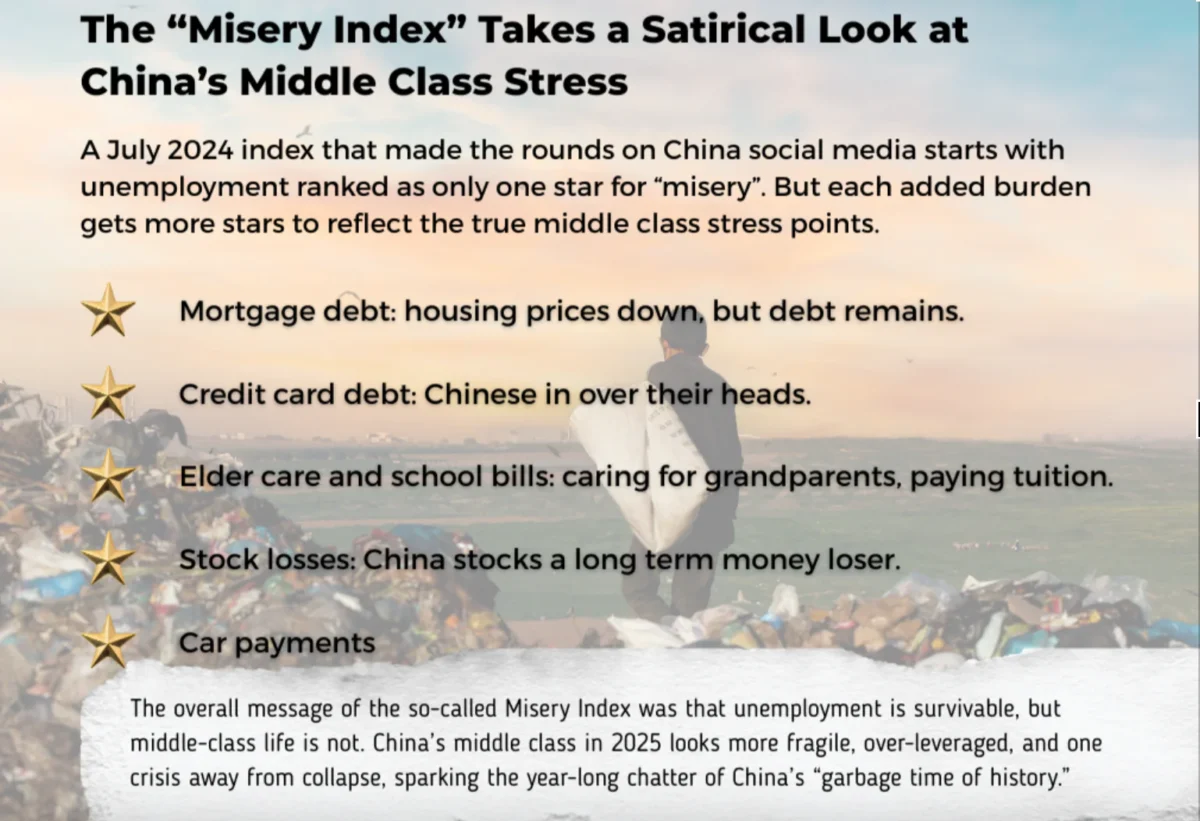
The phrase “garbage time of history” is famous in communist countries, dating back to the Soviet Union. But in China, it became a common phrase and meme on social media in July 2024 following the publication of a snarky, tongue-in-cheek index mocking a general sense of decline in the quality of life in the country.
Through an American lens, the index’s “maximum misery” almost appears mainstream. It defined maximum misery as having a mortgage, car payment, credit card bills, student loans, and collecting unemployment—a standard for middle class America. But the bigger takeaway is that the Western image of China simply cranking out tech geniuses building start-ups, STEM PhDs inventing new cancer drugs, and symphonic violinists is distorted. Like here, there are many college educated Chinese working as delivery drivers, or struggling to find entry level employment. For blue collar workers, it might be worse. Factories are moving to Southeast Asia to avoid higher tariffs imposed by China’s biggest export market—the United States.
“Garbage time” refers to the period when a nation or system is no longer viable—when it has ceased to progress, but has not yet collapsed. Chinese essayist Hu Wenhui coined the fuller phrase "lìshǐ de lājī shíjiān"—“the garbage time of history” in a 2023 WeChat post.
It’s not just the lower income Chinese that are complaining. It’s also the middle and upper echelons of Chinese society.
One way to gauge the concern over China’s future is to look at the number of people in China that have money outside of China. In 2018, Chinese individuals spent around $13.4 billion on U.S. real estate. Then COVID-19 hit. And by 2024, Chinese individuals slightly increased their purchases of U.S. homes to $13.7 billion. They are the top foreign buyer in the United States. The same holds for Australia where Chinese individuals and businesses were approved for $6.07 billion purchases in both residential and commercial properties, rising to $7.9 billion in 2024. Knight Frank noted on Aug. 22 that overseas buyer home purchases in greater Seoul have grown 26 percent annually since 2022, with Chinese nationals accounting for almost three-quarters of these purchases, prompting new restrictions.
This year, civil servants—including teachers, health care professionals, employees of state-owned enterprises, and even government contractors—are required to surrender passports, and must now obtain multiple layers of internal approval before traveling abroad, even for personal reasons.
If China is a near-competitor to the United States in AI, according to Nvidia CEO Jensen Huang, a hotbed of innovation for cars and renewable energy, not to mention owners of the factories manufacturing goods sold globally, why do so many people want to leave?
“A lot of people in China are concerned about the political tightening and the state of the economy,” said Chris Balding, founder of Siphtor, a big data platform, and an ex-professor at Peking University. “They want to get money and family out of China. That is why you see such large amounts of demand from Chinese to move, and another reason why you have 300,000 Chinese students in the U.S. There is a lot of pressure building,” Balding told NTD.
Kenneth Rapoza/NTD News
CCP Criticism Spreads Among Chinese
In September, a discussion series hosted by Los Angeles–based think tank Dialogue China and the June 4th Memorial Museum invited participants from the 1989 pro-democracy movement in China to discuss life in their old home. Museum director, Wang Dan, said the CCP is in the throes of “the garbage time of history” and “could collapse at any moment,” The Epoch Times reported on Oct. 20 in its Chinese-language edition.An anonymous WeChat account going by the name Beast Song wrote about the ongoing garbage times in China Digital Times on Nov. 17. The author said that China’s cultural elite are the ones most sensitive to this phrase.
“During periods of garbage time, whether in the cultural sphere or the economic sphere, everything becomes vastly different from a normal country or a normal society,” the China Digital Times essay said. “Anyone who tries to speak a few honest words—especially words involving reflection—is often attacked by the crowd. Maintaining the status quo is already extremely hard.”
Beijing is not taking these insinuations about its impending doom lightly. It may be one of the reasons for travel restrictions among CCP members working for the regime.
Chinese leader Xi Jinping “has brought out the big guns” to counter this notion that Chinese history is in its "garbage time," said Victor Mair, a well-known linguist and academic studying China in the Department of East Asian Languages and Civilizations at the University of Pennsylvania.
“The probable reason why the government doesn't enforce complete censorship against the phrase is that Hu Wenhui — in his original essay about the concept — does not make explicit claims that it is about the fate of China,” Mair wrote in his blog Language Log. “Sensible netizens avoid making such claims. Of course, if they do step over the line and reference China, their posts will be blocked by the censors.”