


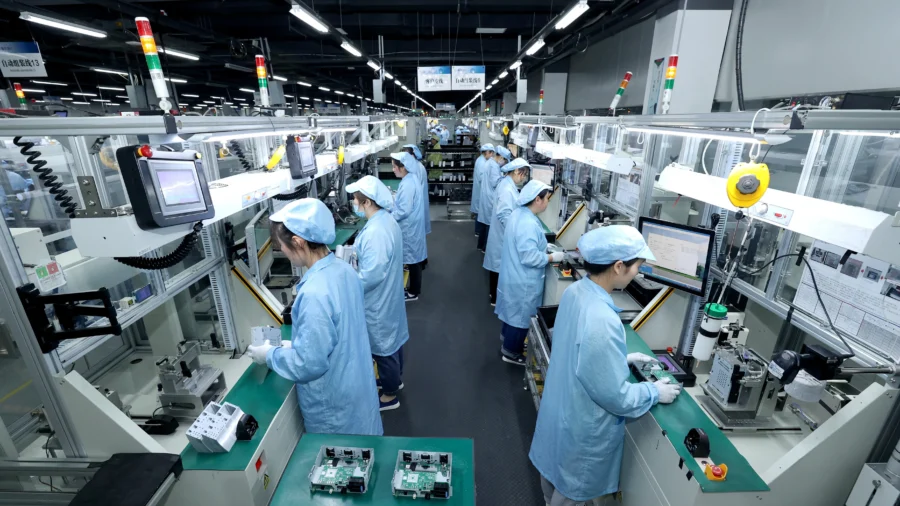
China’s once-dominant manufacturing workforce is facing an unprecedented reckoning. As the U.S. decouples from its supply chains, China’s job market is fracturing—with consequences similar to what American workers experienced after China joined the WTO in 2001.
On Wednesday, Reuters reported that competition for export markets in the face of record-high U.S. tariffs was “crimping industrial profits” and fuelling deflation due to weak local demand. “Workers bear the brunt of companies cutting costs,” was the report’s takeaway.
China’s export dependency for many manufactured goods is well-known. Analysts and leaders from the United States, and even some in Beijing, have talked about the importance of China increasing local consumption. This has been a decade-old project that has not made a dent among the manufacturing segments that are particularly focused on selling to foreigners.
What is China’s real unemployment rate? We might not ever really know. The reported rate has hovered between four and five percent for more than a decade, even in uncertain times such as now. The credibility of the data is widely considered to be unreliable.
Compared to the headlines about trade wars, this figure looks relatively benign. But it masks pressures in the inland manufacturing areas, where demand for labor has been dampened by weak export orders and cautious hiring amid tariff uncertainties.
High U.S. tariffs pose a risk to roughly 100 million export-dependent Chinese manufacturing jobs in the months ahead, the World Bank said. China will try to shift some of these workers into manufacturing jobs that produce more for the local market, such as the automotive industry.
The June World Bank report said that migrant workers in manufacturing—those who come in to work from far-away cities and live in dormitory-style housing often provided by the company—have been “disproportionately affected by the slowdown in exports to the United States.” These people face fewer job opportunities and greater income insecurity than before and are working second jobs, or dabbling in the Chinese gig economy—working part-time in everything from delivery to ride-sharing services.
Southeast Asia Becomes New Factory Floor
Due to higher labor costs in China, and spurred along today by tariffs, Chinese companies are investing more heavily in Southeast Asia. This was already a trend. But the Trump administration’s trade policies have sped up the trend.Chinese foreign direct investment (FDI) into manufacturing in Southeast Asia is surging again this year. Companies are looking to lower their tariff risk.
Manufacturing investments now account for the lion’s share of China FDI in the region. In 2023, Chinese FDI into the ASEAN block nations totaled about $25.1 billion, of which $9.15 billion was invested in manufacturing.
Chinese manufacturers have moved manufacturing of shoes, textiles, and electronics components to countries like Vietnam, Cambodia, Indonesia, and Myanmar. And even though all of those countries are set to have higher tariffs beginning Aug. 1, their tariff rates are either lower or on par with China tariff rates.
Cambodia is next on the receiving end of China corporate investment and manufacturing contracts.
In the past, many of these investments would have gone to mainland China, for Chinese workers. Tariffs, and other radical changes in the Chinese economy—a focus on high-tech globalized industries like semiconductors and aerospace—has changed the labor landscape for China.
At the start of this year, prior to the higher tariff announcements by Trump in April, China’s part-time employment workforce reached about 240 million people—roughly 21 percent of the country’s total employed population. Of these, around 84 million workers are in the gig economy. A lot of that labor might be involuntary, meaning the workers have no choice for now. Without the buffer in gig work, China’s labor pains from manufacturing downturns and tariff-related layoffs would be even more severe.