


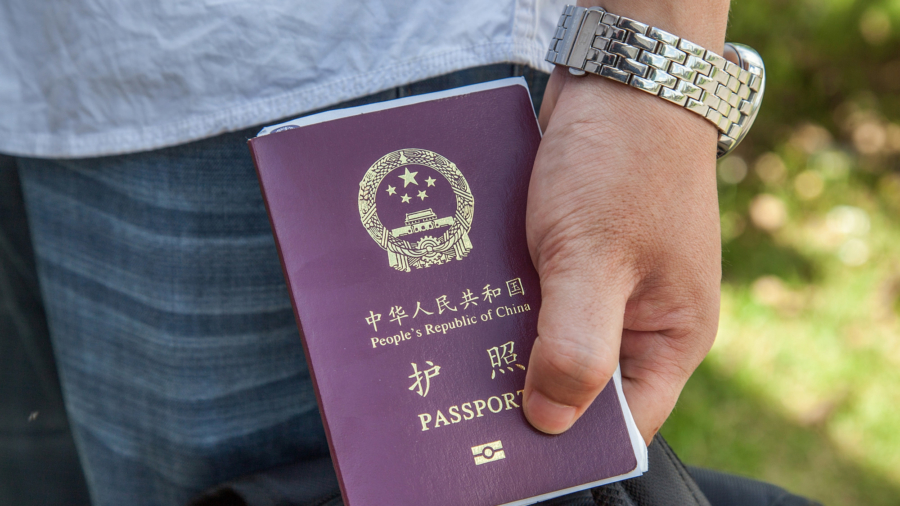
The Chinese regime has intensified its passport confiscation campaign, now encompassing low-level civil servants.
Analysts suggest the Chinese Communist Party (CCP) aims to prevent civil servants from defecting to the West while mitigating economic losses caused by capital flight.
Civil servants, including those at the junior level, employees of public institutions, and state-owned enterprises across various regions have been required to turn in their passports for “safekeeping” by their management.
On 28 July, Guo, a retired civil servant and former division chief from Beijing, told The Epoch Times that many section heads and deputy section heads—low-ranking positions in China’s civil service hierarchy—have been required to hand in their passports and Hong Kong/Macau travel permits.
“They say it’s for collective keeping of passports. If you want to travel abroad, you must first submit a written application, which requires approval from several levels of management, and final approval from the human resources department.”
Liu, a low-level manager at a central state-owned enterprise who recently returned from an overseas trip, also told The Epoch Times that he had to submit an application one month in advance before travelling abroad, detailing the reasons for the trip, companions, destination, and other information.
“If it’s for visiting relatives, you have to fill out an additional form. There were no such requirements a few years ago,” he said.
The CCP tightened passport control measures around the early 2000s, when China saw a rise in “naked officials”—civil servants sending spouses and children to live overseas as permanent residents or foreign nationals, and often transferring ill-gotten wealth abroad as a prelude to their own potential departure.
At that time, only officials at or above the deputy division level were required to turn in their passports to local authorities. Although some needed approval to travel abroad, certain local officials were allowed to retain their passports.
Fear of Scandals Leak
Since COVID-19 pandemic restrictions ended, the CCP has gradually intensified controls on party members' overseas travel, solicitor Ren told The Epoch Times.When travelling abroad, members must submit detailed itineraries, even for private trips. The regulations also prohibit defecting or facilitating others’ defection, such as assisting with the purchase of train, ship, or plane tickets, or offering a place to stay, according to the regulations.
Ren said that “naked officials”—those whose families live abroad as permanent residents or foreign nationals—are now increasingly targeted as potential defectors.
“They fear these people will defect. It’s not only a loss of face for the regime, it’s economic losses as well,” Ren said.
He added: “Many of those knew the inside scandals within the CCP’s system. This might be the main reason the CCP doesn’t want people, especially those within the system, to go abroad. They fear they might expose their scandals.”
Economic Woes
Ren said economic concerns are another key driver behind tightened restrictions.“Domestically, civil servants aren’t even allowed to go out for dinner or banquets anymore. Let alone go on publicly funded trips abroad,” he said.
Amid China’s economic slowdown, some civil servants face salary cuts or even wage arrears. China’s fiscal revenue growth slowed significantly in 2024, rising by only 1.3 percent compared to a 6.4 percent increase in 2023, straining government budgets.
Local governments, heavily reliant on land auctions, saw a 16 percent drop in revenue from sales to developers due to a prolonged real estate slump.
In response, some local authorities have taken an unconventional step by allowing civil servants to take on part-time work.
“I believe another reason is reducing fiscal spending. [Civil servants] always have excuses to arrange so-called inspections or cooperative trips abroad. It’s likely that approvals will be completely denied or simply not granted after the passports are taken,” Ren said.
Even retired civil servants are being controlled. Guo said that a retired colleague from a small county in Guangxi who had obtained permanent residency abroad was required by his former management to hand in his passport upon returning to China to visit family.
Fears of Mass Exodus
Not only public sectors, but also Chinese citizens across various sectors report significant barriers to obtaining or retaining passports, driven by concerns over a potential mass exodus.Liu, a low-level manager who recently returned from an overseas trip, told The Epoch Times that his wife, a university teacher, was also required to surrender her passport.
“She took our child to Malaysia for Chinese New Year, but when she applied to travel abroad again during the summer holidays,” he said. “Her management rejected the application, saying ‘only one international trip per year is allowed.’ Her supervisor even questioned her about whether she was considering emigration.”
Similarly, Liao from Guangzhou said restrictions are affecting even primary school teachers. “My friend who teaches at a primary school had her passport confiscated by her management,” she said.
She lamented: “‘Travel on a whim’ simply doesn’t exist for us anymore. If you want freedom to travel abroad, you have to leave the system.”
In Henan Province, central China, Chang Yong (a pseudonym) from Xinyang City told The Epoch Times that many cities have halted passport issuance entirely.
In Guizhou, a southwestern province, some regional authorities have gone further, confiscating passports directly from residents under the pretext of “holding them on their behalf.”
“[I think] the authorities just discontinued processing [passports] as too many Chinese fled the country around the [New Year] holidays,” Chang said.
The surge in Chinese citizens attempting to leave the country, sometimes through dangerous routes, underscores these concerns.
According to U.S. Customs and Border Protection (CBP), over 24,000 Chinese nationals illegally crossed the U.S. border from northern Mexico in the 2023 fiscal year (Oct. 1, 2022, to Sept. 30, 2023).
This number continued to rise, with 4,261, 4,797, and 5,980 crossings recorded in October, November, and December 2023, respectively. Some individuals have even risked their lives traversing South American rainforests to reach the United States.