This year marked an increase in pressure on Chinese multinationals and investment vehicles investing in the United States. For China, it was not for the better. Next year, judging by the Trump administration's
America First Investment Policy—published in February—investments by Chinese companies are immediately circumspect.
Some investments have already been canceled because of the geopolitical tensions between the United States and China.
Michigan’s government once
bragged about the Gotion investment. But DC politics changed all that. In October, the Michigan Economic Development Corp. said Gotion’s electric vehicle battery parts plant project was dead and will no longer be getting any state funding.
China media and technology company Tencent was ready to invest $1 billion to be a partner in the Paramount-Skydance bid for Warner Bros. But this month, Tencent
withdrew from the deal. The revised bid removed Tencent’s funding and went forward with other financiers instead.
It was likely that Tencent’s involvement would have triggered a national-security review, an issue that Warner Bros. had raised with Paramount,
according to the South China Morning Post, citing filings with the Securities and Exchange Commission. In January, the Pentagon labelled Tencent a
“Chinese military company,” increasing those odds.
For China companies, even major private ones like Gotion and Tencent, the America First Investment Policy means more scrutiny.
The Trump policy
says Washington “will use all necessary legal instruments, including the Committee on Foreign Investment in the United States (CFIUS), to restrict China-affiliated persons from investing in United States technology, critical infrastructure, healthcare, agriculture, energy, raw materials, or other strategic sectors.”
The policy also seeks to strengthen CFIUS authority over “greenfield” investments—like Gotion’s, whereas the investment requires building a factory from scratch, in order to restrict China’s access to sensitive technologies.
China State Capital: A Quiet Exit?
China Investment Corporation (CIC), the country’s
$1.3 trillion sovereign wealth fund, has quietly adjusted its global footprint in ways that reveal Beijing’s evolving risk calculus. CIC is a bellwether for how Beijing invests globally. And so when CIC pulls back from U.S. investments, namely into private funding vehicles like private equity and venture capital, it does not necessarily mean Beijing is taking profits; it reflects geopolitical tensions rather than any financial strategy.
CIC has reduced its exposure to private equity and alternative investment funds, according to multiple
reports.
China’s Sovereign Wealth Fund Decouples:
- Halting new commitments to U.S. private equity firms like KKR and Carlyle Group;
- Redeploying capital into Asia and recently with Saudi Arabia’s Investcorp, due to fewer geopolitical risks
China Now Cautious on Europe, Mexico, Too
A December 2025 note in the publication Global Competition Review
said Chinese businesses were also suspending or reshaping deals in Europe because of fear that the EU’s Foreign Subsidies Regulation will force disclosures into China financing, or lead to investing prohibitions.
China companies that are heavily subsidized back home, such as EV battery makers and the wind turbine supply chain face the risk of Brussels demanding remedies or blocking corporate investments into economic sectors deemed important to European industry—like automotive and wind energy.
Former EU diplomat in Beijing,
Charles Parton, told the House Select Committee on the CCP in a
hearing on Dec. 11 that, “The Chinese Communist Party sees itself at war with you and with us. That war is not so much a trade war; it is a war between economic systems and above all, a science and technology war.”
It is sentiment like that which behooves China’s state, and private directed capital, from investing in the United Staters. They are now thinking twice. Washington seems fine with that.
Speaking during Thursday’ House Select Committee hearing, committee member Rep. Young Kim (R-Calif.) warned that China companies have a history of deploying backdoor tactics to gain access to American markets otherwise restricted. She mentioned China investments in Mexico.
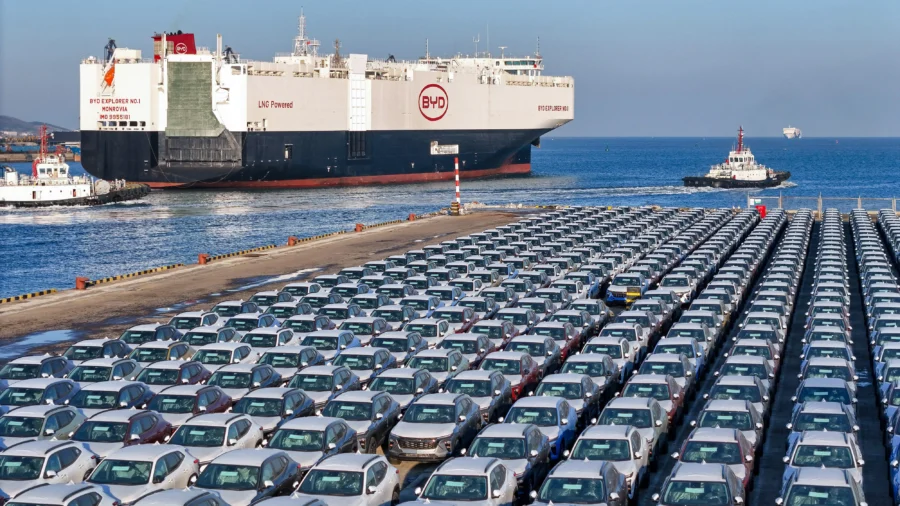
Even here, big China companies are pulling back as the spotlight hits their Mexico investment activities. Automotive giant BYD
paused investment plans there, citing geopolitical sensitivity.
Like China’s
record exports of manufactured goods, their outbound investment hasn’t collapsed; instead, it has shifted direction. China funneled nearly $80 billion into overseas clean-tech projects in the past year,
according to Climate Energy Finance, an Australian think tank specializing in decarbonization. Most of the money went to developing markets, but some went to building EV battery plants in Spain and France.
China’s private sector is re-evaluating investments in politically sensitive regions, led by the United States. Their biggest companies might be exiting the United States out of fear of sanctions or public pressure like Gotion faced in Michigan, but they are still expanding elsewhere. Next year will likely see more of the same: a strategic repositioning away from mostly United States exposure toward industrial sectors and geographies deemed safer by Beijing.