


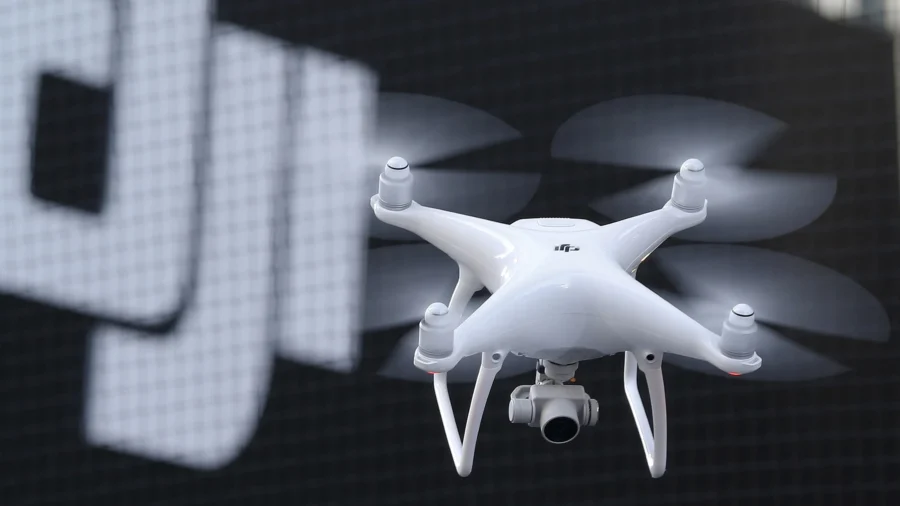
Chinese drone manufacturer DJI has announced that from Jan. 13, it is removing its geofencing system for drones sold in the United States. Software updates from the company will no longer include a function preventing drones from entering restricted airspace, replacing it with a simpler warning system.
The move means that DJI drones will not block flights over sensitive areas such as airports and military bases. Instead, operators will receive a warning if their drones approach certain “enhanced warning zones.”
In a blog post, the company said the decision places control "back in the hands of the drone operators." However, former DJI policy and legal affairs executive Brendan Schulman expressed concerns about the impact on aviation safety.
Lai Jianping, chairman of the Canada Branch of the Democracy Party, told NTD that this change poses significant security risks, including damage to critical infrastructure. He added that "without geofencing restrictions, DJI drones could become a considerable threat to U.S. security."
Sheng Xue, a Canadian-Chinese writer, told NTD that the Chinese Communist Party (CCP) seeks to challenge the security of countries like the United States. She believes DJI drones are part of this effort.
"DJI drones have long been suspected of serving as surveillance tools," Sheng said. "Now, the CCP seems to be speeding up its influence over the United States. This is a major concern."
Despite these restrictions, DJI drones still dominate the global market, and the United States remains the company's largest market.
Chen Shihmin, a political science professor at National Taiwan University, says that DJI has established a strong presence in the U.S. market in recent years. He told NTD that the company now appears to be leveraging its market position to influence U.S. policy and that the CCP is clearly displeased with the U.S. ban on new drones.
Lai said that the cancellation of the geofencing feature likely stemmed from the CCP, stating that "DJI would not have made this move independently." He said that the issue reflects broader diplomatic tensions between China and the United States.
Lai also said that DJI drones and TikTok are not just commercial products or services, but are part of a broader national security challenge from the CCP. He is urging the United States to consider a comprehensive strategy that should include a ban on such technologies.