


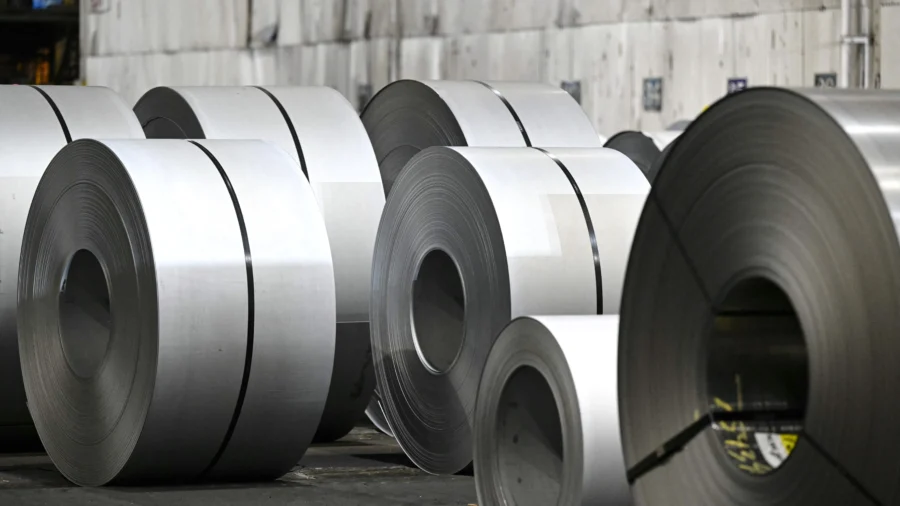
The Commerce Department on Friday added hundreds of derivative products that will be subject to the 50 percent tariffs President Donald Trump imposed on steel and aluminum imports.
The Department’s Bureau of Industry and Security stated that it was adding 407 Harmonized Tariff Schedule of the United States (HTSUS) codes to the list of steel or aluminum derivative products.
Another 60 HTSUS codes were not added to the list as they remain subject to ongoing trade investigation, the bureau stated.
It also stated that non-steel and non-aluminum content will be subject to reciprocal tariff rates that the U.S. government has imposed on certain countries and other applicable tariffs.
Trump told reporters aboard Air Force One on Friday that he will be setting tariffs on steel and semiconductor imports.
“I’ll be setting tariffs next week and the week after on steel and on, I would say, chips,” the president said, though he gave no details on the tariff rates.
“I’m going to have a rate that is going to be lower at the beginning that gives them a chance to come in and build, and very high after a certain period of time,” he said.
Trump in April imposed a 10 percent baseline tariff on nearly all U.S. trading partners, along with reciprocal tariffs that vary depending on their trade barriers with the United States, in order to address trade deficits. He later implemented a 90-day pause on the reciprocal tariffs before extending the reprieve to Aug. 1 to allow time for negotiations.
In his order, Trump said that some trading partners have agreed to or are close to making “meaningful trade and security commitments with the United States,” while others have proposed terms that he thinks do not adequately address trade imbalances or “align sufficiently with the United States on economic and national-security matters.”