


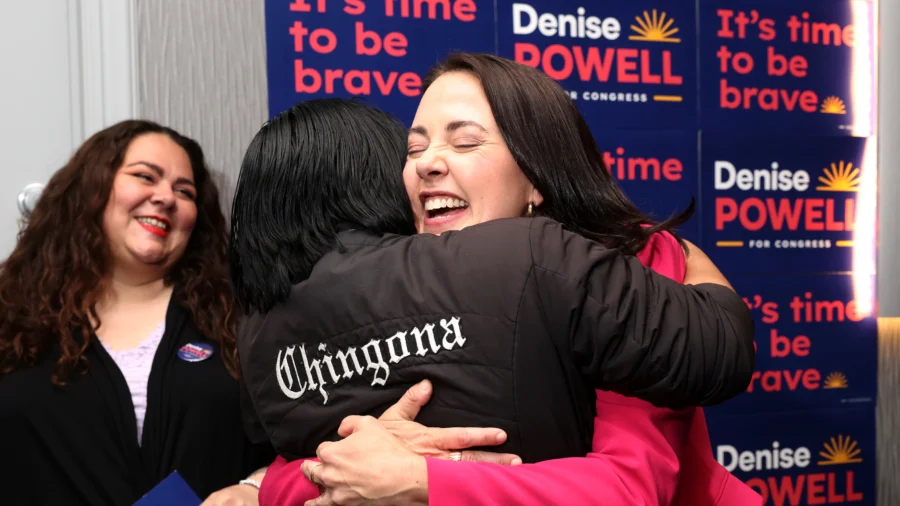
OMAHA—Nebraska Democrat Denise Powell will face Republican nominee Brinker Harding in the Nov. 3 general election as both parties continue their fight to represent an area that’s come to be known as the “Blue Dot.”
Powell bested Nebraska state Sen. John Cavanaugh by a narrow margin, obtaining 38.9 percent of the vote for the Democratic nomination to run for Nebraska’s 2nd District House seat. Cavanaugh trailed closely behind at 36.8 percent support and a difference of 1,080 votes with 89 percent counted.
The Democrats campaigned against the leadership of the Trump administration as much as they did against each other.
Powell, a mother and small business owner, accused Cavanaugh of aligning with Republican President Donald Trump to muzzle Democrats on key issues such as abortion.
Citizens Vote
Omaha resident Linda Johnson said she voted for Powell because she believes Powell can best hold onto the district.“I voted for Denise Powell because she’s going against Cavanaugh and I’m concerned about losing the Blue Dot,” Johnson told The Epoch Times.
Congressional District 2 is known as the Blue Dot because it’s historically been considered a Democratic district in a Republican state. The district contains Douglas and Saunders Counties, as well as western Sarpy County.
Jackson Lindsay arrived at the Ward 1 polling place in Precinct 27 with his dad to vote for the first time. The recent high school graduate said he believes a Democrat is a better fit with the demographics of the Blue Dot.
“That way, you have a more diverse voice in the state,” he told The Epoch Times.
Lois Hopgood voted at the Nathan Hale Magnet Middle School polling place. She did not want to say who she supports. She said she made her decision after studying each candidate.
She hopes that whoever wins will use the position to bring the country together and heal the divisions in society.
“Whether Democrat, whether Republican, I think that we need a better line of communication,” Hopgood told The Epoch Times.
Nebraska Democratic Party Chair Jane Kleeb said the blue party in Nebraska will focus on kitchen table issues and how it will meet the needs of Nebraskans that she said are being neglected by the Trump administration.
She said culture war issues, while important, are not the biggest problems facing the working class in Nebraska and around the country. Housing affordability, health care, employment, the cost of living as seen in the high prices of gas and groceries, are all areas where Trump has fallen short, Kleeb said.
Top Issues for Nebraska
Nebraska Republican Party Chair Mary Jane Truemper expects the race to be a challenge. But she believes Harding can prevail by focusing on the same issues the Democrats hope to capitalize on.Harding—an Omaha city councilman who was unopposed in the GOP primary—touted his record on the city council as well as endorsements from various Nebraska officials as reasons Nebraskans should vote for him in November.
He expressed confidence in his ability to win during an election night watch party. Harding said the Democrats are running to protect the Blue Dot, which he says only represents part of the district.
"The Blue Dot is representative of only some of the people in the second district," Harding told The Epoch Times. "I'm running to represent all of the district."
Truemper said that while District 2 is a blue area in a sea of red, the most serious issues cross party lines.
Immigration, the economy, high taxes, voter ID, crime, support for the military, and the expansion of rural broadband services are some of the issues that Nebraskans are concerned about, she said.
Truemper believes that Harding’s background in business and government has equipped him to help address those concerns.
Still, she would like to see Nebraska change the way it allocates its Electoral College votes during presidential elections to a winner-take-all system. She said the battle over the district has drawn major campaign contributions from out-of-state.
“That's one of the reasons that I have been so firmly in favor of a winner-take-all system to [get] extra money out of this, out of the state system, because it really has effect on the down ballot races as well,” Truemper told The Epoch Times.
In Nebraska, the overall winner in a presidential race receives two of the state’s five electoral votes. The remaining three votes go to the winner of each of the state’s three congressional districts. In a close race, this makes winning each of the three districts imperative.
In 2024, Republicans in Nebraska’s unicameral Legislature pushed a bill supported by Republican Gov. Jim Pillen to switch the state to a “winner-take-all-model.” But their efforts were rebuffed.
Kleeb said the Nebraska system ensures that presidential candidates—especially in close races—pay attention to what is going on in the Cornhusker State. If a presidential candidate wants to win all of Nebraska’s electoral votes, they must appeal to voters across the entire state.
“So it's a much more fair way to distribute electoral votes, because if you have a congressional district that leans more democratic, or let's say [in] California, more Republican, you would be able to, as voters, have your voices heard, rather than get swallowed up with the state,” she said.