

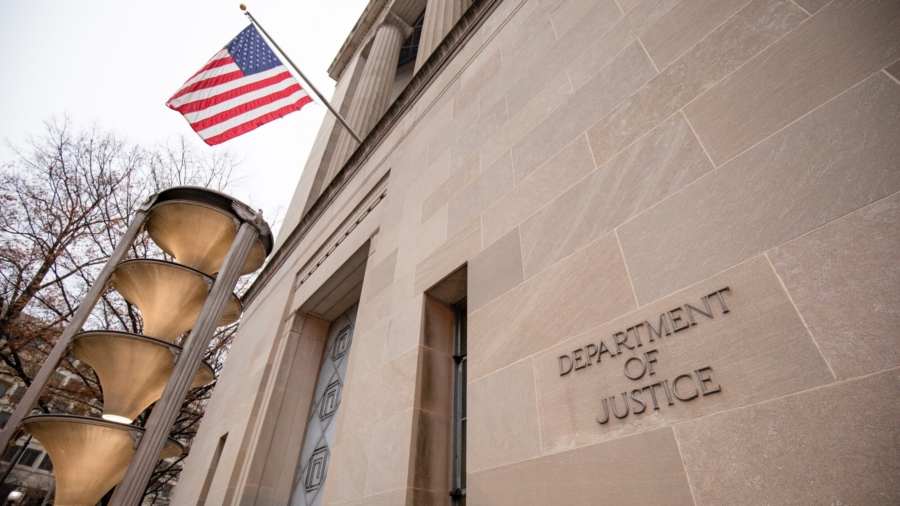
The Justice Department (DOJ) this week released a part of a legal memorandum that assisted then-Attorney General William Barr in his decision on whether to prosecute then-President Donald Trump for obstruction of justice during the Mueller special counsel investigation.
At issue in this case was whether the department could keep portions of a March 24, 2019, internal memo hidden from the public using an exemption to the Freedom of Information Act. The federal court ordered that the memo was to be disclosed in full to the public.
The newly unredacted part of the memo shows how top officials at the department's Office of Legal Counsel made the argument in favor of Barr reaching a public determination on whether to prosecute Trump for obstruction of justice. The official had determined that then-special counsel Robert Muller had not reached the conclusion in his report and recommended that Barr take on the endeavor.
In 2019, Barr announced that Mueller did not provide sufficient evidence to support an obstruction of justice case.
The release of the memo came in a case brought by the nonprofit organization Citizens for Responsibility and Ethics in Washington (CREW), which had filed a public record request for the information that Barr had reviewed prior to his public announcement concerning special counsel Robert Mueller’s report in which he dismissed allegations that the Trump campaign had colluded with Russia in the 2016 presidential election.
The organization was seeking the documents used in those consultations with department lawyers.
DOJ attorneys argued that the March 24, 2019, memo was "advice and analysis" provided prior to Barr making a decision on the question of whether to prosecute Trump. However, Jackson rejected the DOJ's arguments, saying that at the time Barr received the memo, he and the writers had a shared understanding over the decision not to prosecute Trump and therefore, the document wasn’t “predecisional.”
She also concluded that the memo represented “strategic, as opposed to legal advice” and would fall outside the scope of the exemption.
The DOJ is disputing Jackson's conclusion about the document, arguing that the judge reached the conclusion because the department had “incorrectly described the nature of the decisional process” that Barr was engaged in when he referred to the memo in their filings. They added that the imprecision in its description of the decisional process is what led the court to determine that the memo should not be protected by the deliberative process privilege.