


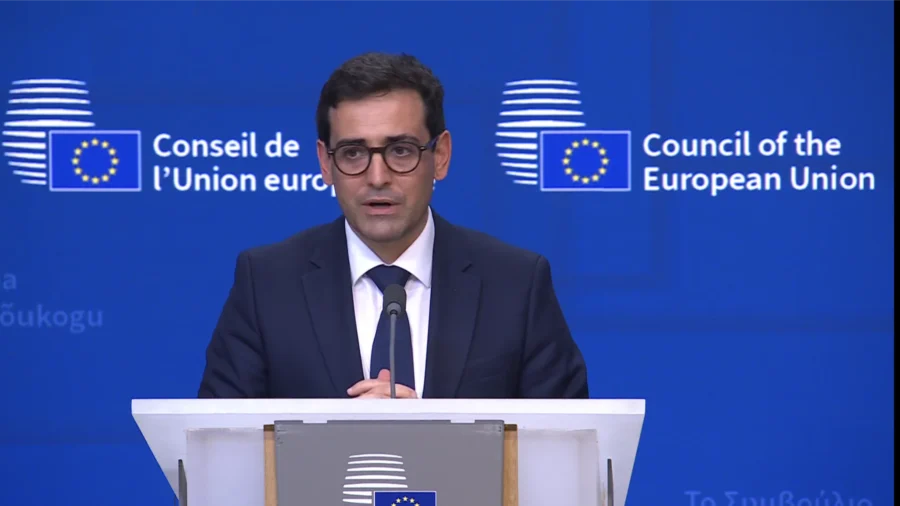
The European Union’s industry chief warned companies on May 22 to move faster in reducing reliance on China-dominated supply chains, speaking after a meeting of EU trade ministers in Brussels that focused on economic security, global supply-chain disruption, and diversification.
He said companies should update their business plans so that, for example, “not 100 percent” of raw materials for a given product come from one country.
Ministers Call for Open Trade, Less Exposure
The diversification message was not limited to Séjourné.Michael Damianos, Cyprus’s minister of energy, commerce, and industry, said in the Council summary that trade can strengthen EU resilience and strategic autonomy by helping the bloc “diversify and derisk.” Cyprus currently holds the rotating presidency of the Council of the EU.
Latvian Parliamentary Secretary Artjoms Ursulskis said that economic security and open trade are not opposing goals.
“The EU must be able simultaneously to strengthen the resilience of supply chains and actively expand cooperation with like-minded and reliable partners,” he said, according to Latvia’s Foreign Ministry.
Irish Foreign Minister Helen McEntee said before the meeting that ministers would discuss how the EU can strengthen economic resilience and reduce strategic risks linked to regional instability. She also said the EU’s free trade agreements are “integral” to diversifying critical supply chains and opening export markets for European companies.
Rare-Earth Controls Add Pressure
The EU warning follows two rounds of Chinese rare-earth export controls that sharpened concerns over supply-chain exposure.China’s Ministry of Commerce and General Administration of Customs announced controls on several medium and heavy rare-earth-related items on April 4, 2025. The notice said the measures were adopted to safeguard national security and interests and fulfill non-proliferation obligations. It required exporters to apply for licenses for listed items, including products related to samarium, gadolinium, terbium, dysprosium, lutetium, scandium, and yttrium.
Beijing expanded the controls on Oct. 9, 2025. China’s Ministry of Commerce and customs authorities announced additional restrictions on items related to holmium, erbium, thulium, europium, and ytterbium, with implementation set for Nov. 8, 2025.
A separate Chinese Ministry of Commerce notice issued the same day applied controls to certain overseas rare-earth-related items. The notice said foreign entities must obtain Chinese dual-use export licenses in some cases when exporting products outside China that contain Chinese-origin rare-earth items or are produced using Chinese-origin rare-earth mining, smelting, separation, metal smelting, magnet-making, or recycling technology.
The European Parliament said in November 2025 that China introduced two waves of rare-earth export controls in April and October 2025, and later suspended the second wave until November 2026. According to the briefing, the export controls significantly affect the EU, as rare earth elements are essential inputs for the digital, renewable energy, and defense sectors.
EU Policy Already in Motion
The EU’s Critical Raw Materials Act sets 2030 benchmarks for strategic raw materials: at least 10 percent of the EU’s annual consumption should be extracted in the EU, 40 percent processed in the EU, and 25 percent recycled in the EU. The law also says no more than 65 percent of the EU’s annual consumption of any strategic raw material should come from a single third country.In December 2025, the European Commission adopted the RESourceEU Action Plan to reduce strategic dependencies in critical raw materials. The Commission said the plan would support diversification, recycling, stockpiling, joint purchasing, and investment, with an immediate focus on rare-earth permanent magnets, battery raw materials, and defense-related materials. It said the plan would mobilize nearly €3 billion (about $3.48 billion) over 12 months.
Coordination With Washington
The EU has also strengthened coordination with the United States on critical minerals supply chains.On April 23, the EU and the United States signed a memorandum of understanding in Washington, establishing a strategic partnership on critical minerals. The commission stated the agreement establishes an EU-U.S. Critical Minerals Action Plan covering extraction, processing, recycling, investment, and supply-chain security.
At the council press conference, Séjourné said Europe must “make full use” of trade partnerships and free trade agreements, work with member states and European businesses, and avoid new strategic dependencies. He also emphasized that the EU should bolster domestic production and value-added activities in Europe, including through initiatives such as the Industrial Accelerator Act.