


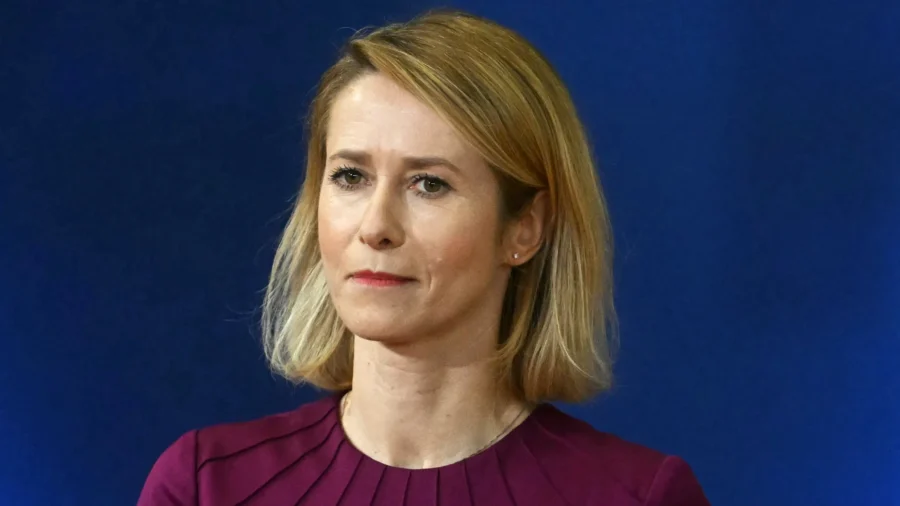
Europe must "step up" to ensure its own defense as the United States' focus shifts away from the continent, the European Union's foreign policy chief, Kaja Kallas, said on Jan. 28.
"Let me be clear: We want strong trans-Atlantic ties. The U.S. will remain Europe’s partner and ally. But Europe needs to adapt to the new realities. Europe is no longer Washington’s primary center of gravity," Kallas said, according to an official transcript of the speech.
"This shift has been ongoing for a while. It is structural, not temporary. It means that Europe must step up—no great power in history has ever outsourced its survival and survived."
It also said that it would encourage partners in other parts of the world, including Europe, to take primary responsibility for their own defense "with critical but limited support from U.S. forces."
U.S. President Donald Trump has been pushing for increased defense spending to address an imbalance between what the United States contributes to NATO and what its allies contribute.
According to NATO, the imbalance between what the United States and other allies spend on defense “has been constant."
Complementary to NATO
Kallas told the audience that although Europe must build up its own defense procurement, training, and investment to put European militaries in a stronger position, the EU needs to ensure these initiatives remain complementary to NATO."We need to sync our efforts, together with NATO, so as to complement each other," she said. "And to demonstrate how a distinct European pillar adds value through more burden sharing and military strength on our continent."

Rutte also said that the continent cannot defend itself without the United States, and he cautioned against the notion of a separate European army—a proposal raised by European leaders, including Spain’s minister for foreign affairs, José Manuel Albares—suggesting that to replace the support that Washington supplies would require a significant increase in defense spending.
“For Europe, if you really want to go it alone, and those who you are pleading for that, forget that you can ever get there with 5 percent. It will be 10 percent,” Rutte said.
“You have to build up your own nuclear capability. That costs billions and billions of euros. You will lose, then in that scenario, you would lose the ultimate guarantor of our freedom, which is the U.S. nuclear umbrella. So hey, good luck.”