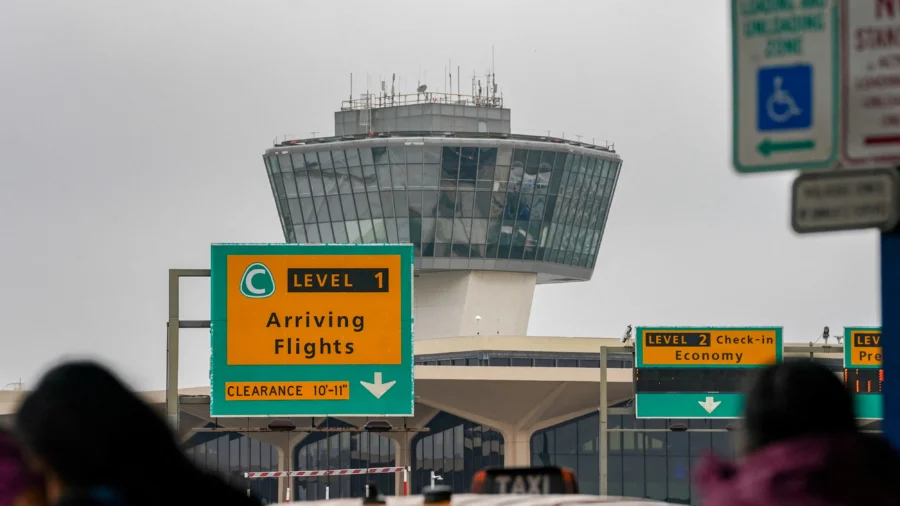
The Federal Aviation Administration (FAA) announced on May 16 a proposal to temporarily limit the number of flights per hour at the Newark, New Jersey, airport following meetings with major airlines.
The FAA held several rounds of individual meetings with air carriers during the week of May 11–17 to discuss flight scheduling reductions as the airport grappled with equipment outages, runway construction, and staffing shortages.
Air carriers that participated in the talks included United Airlines, Delta Air Lines, JetBlue Airways, American Airlines, Alaska Airlines, Spirit Airlines, and Allegiant Air, according to the FAA.
Outside the construction period, the FAA proposed capping arrival and departure rates at 34 each per hour, for a total of 68 flights per hour, until Oct. 25, 2025. A final decision on the flight scheduling reductions will be made after the public comment period ends on May 28, according to the FAA.
The FAA told The Epoch Times by email that it intends to add three new high-bandwidth telecommunications connections and replace existing copper telecommunication lines with fiber-optic technology to ensure greater bandwidth.
The agency stated that a temporary backup system will be deployed to the Philadelphia Terminal Radar Approach Control (TRACON) during the switch to the fiber-optic network. The agency also plans to increase air traffic controller staffing, according to its statement.
According to the agency, the proposal will help “reduce overscheduling, flight delays, and cancellations to an acceptable level” at the airport.
“This math doesn’t work. Especially when there is weather, staffing issues or technology breakdowns—the airspace, taxiways, and runways get backed up and gridlock occurs,” Kirby stated.
The move was intended to address staffing issues at the New York facility, but Duffy said it was dangerous because the Philadelphia TRACON has to be fed data from New York through old copper data lines, which were already vulnerable.
Duffy said the FAA implemented a software patch to fix the problem and replaced copper communication lines with fiber optics at Newark, John F. Kennedy International Airport, and LaGuardia Airport, but he said subsequent testing will likely take up to two weeks before the FAA can “flip the switch and make them live.”