

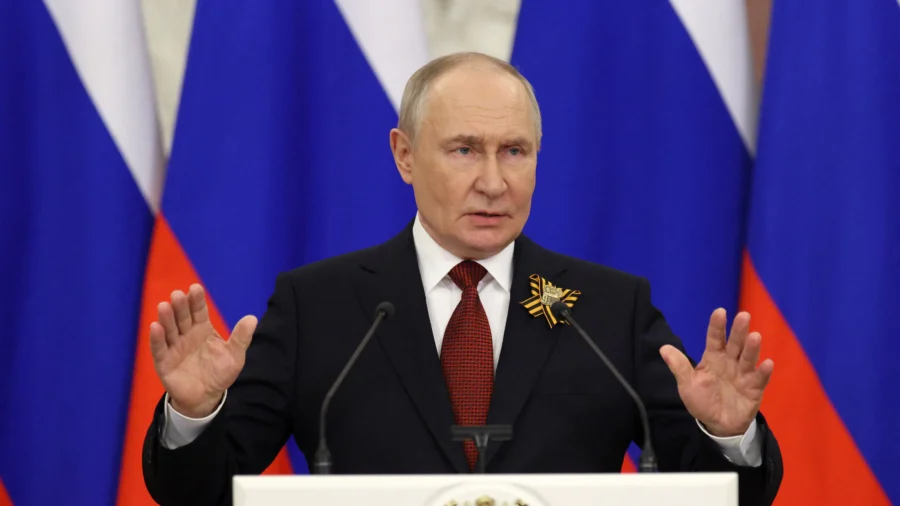
Russian President Vladimir Putin offered renewed optimism that the conflict between Russia and Ukraine could come to an end after more than four years of direct fighting.
“I think it’s coming to an end, but it’s still a serious matter,” Putin told reporters in Moscow on May 9, as Russia held Victory Day celebrations commemorating the end of World War II.
Though the sides agreed to pause fighting during the Victory Day celebrations, the festivities in Moscow lacked the military vehicle parades seen in past years. Putin said the military needs to focus on the war with Ukraine.
“We decided that we would definitely hold festive events, but without the demonstration of military equipment, not only for security reasons, but above all because the armed forces must focus their attention during the final flare-up of the enemy as part of a special military operation,” Putin told reporters on Saturday.
As he announced the short-term ceasefire, Trump also expressed hope that the war would soon end.
“Talks are continuing on ending this Major Conflict, the biggest since World War II, and we are getting closer and closer every day,” the U.S. president wrote on Truth Social on May 8.
Russian forces currently control about 20 percent of Ukraine’s pre-2014 territory, but have yet to establish control over all of Ukraine’s eastern Donbas region.
In recent negotiations, Moscow has called on Kyiv to relinquish control over a remaining section of Ukrainian-held territory in the Donbas region, in the Donetsk Province. Kyiv has refused to relinquish control over the territory.
During his Saturday press conference, Putin reiterated his condemnation of Western support for Ukraine in the ongoing conflict.
Asked whether he’d be willing to speak with European leaders, Putin said he’d prefer to engage with former German Chancellor Gerhard Schröder, who held the chancellorship from 1998 to 2005.
As chancellor, Schröder had been a proponent of the Nord Stream gas pipeline connecting Russia and Germany. Schröder has been on friendly terms with Putin in the years since his chancellorship.