


An indictment was unsealed on July 10 by the Federal Bureau of Investigation (FBI), charging Xudong Yao with nine counts of theft of trade secrets.
This case comes amid rising concerns regarding national security risks in awarding federally-funded contracts to Chinese state-owned-enterprises in the United States, such as the China Railway Rolling Stock Corp (CRRC).

"They want to gather as much data on the movement of people ... and people ride trains every day," Olsen said. "The Metro system in D.C. carries members of Congress, defense personnel, there's a stop at the Pentagon—it goes under most federal buildings."
Sen. Warner of Virginia (D), Rep. Harley Roda (D-CA), and other lawmakers have all raised the same concern.
After Yao was terminated from the Illinois rail company in 2015 for reasons unrelated to the alleged theft, he left the United States to start working for an automotive telematics company in China.
Later that year, he returned to the United States carrying copies of information he previously stole in hand, the FBI alleges. He was also said to have copied explanations on how the stolen technical documents and software codes worked.

Australia Serves as Case-Study
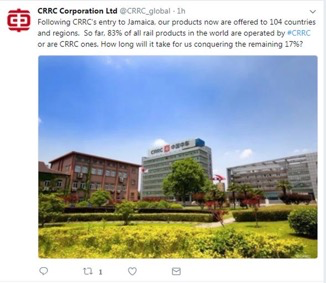
Olson said that this is not only about security risks—China has laid out a blueprint for dominating the world's high-tech industries in the next six years: "Made in China 2025."A now-deleted tweet from CRRC captured by Olsen confirmed the state-owned enterprise's very public intention of "conquering" the rail industry worldwide.
Australia provides a good case-study of how China has been working to do so, said Olson, referring to the country's rail industry that was completely taken over by the CCP over the course of nine years, after CRRC moved in and drove out domestic competitors.
The Rail Security Alliance also warned of parallels between Australia and the United States for railroad security risks. In Australia, CRRC entered the industry by winning transit contracts. CRRC has already won four federally-funded transit contracts in the United States in four years.
Following the alliance's warnings, lawmakers devised plans to introduce a Transit Infrastructure Vehicle Security Act. The act would ban tax-payer dollars from funding Chinese state-owned-enterprises.
"Our core deep belief is that U.S. tax-payer dollars should not be going back to China, they should be staying here in the United States," Olsen said, adding that "CRRC is trying to produce as much as possible in China and ship it here."
Today, a bill for such an act was passed by the House of Representatives. It will now go to the Senate.