



The Federal Reserve’s preferred inflation gauge was unchanged in July, easing concerns that tariffs are reviving cost pressures.
Core PCE inflation, which strips out noisy signals from volatile energy and food components, ticked up to 2.9 percent year over year from 2.8 percent in June.
Both readings were in line with economists’ expectations.
On a monthly basis, the PCE price index edged up by 0.2 percent, and core PCE increased by 0.3 percent.
While monetary policymakers assess the totality of the inflation data, the Fed places more weight on the PCE price index over the consumer price index (CPI) because it includes a broader range of goods and services. Additionally, the PCE price index’s basket of goods and services is adjusted more frequently to reflect changes in consumer behavior.
The July PCE report was the final inflation reading for the month.
“Inflation is increasing ever so slightly, but right in line with forecasts, and this morning’s PCE data should only increase the probability of a Fed rate cut next month,” Chris Zaccarelli, chief investment officer at Northlight Asset Management, said in a note emailed to The Epoch Times.
Producer prices—a pipeline inflation indicator since it measures prices paid by businesses for goods and services at the wholesale level—unexpectedly increased by 0.9 percent. Import prices, another predictor of prices, rose at a higher-than-expected pace of 0.4 percent.
Trump’s Tariffs
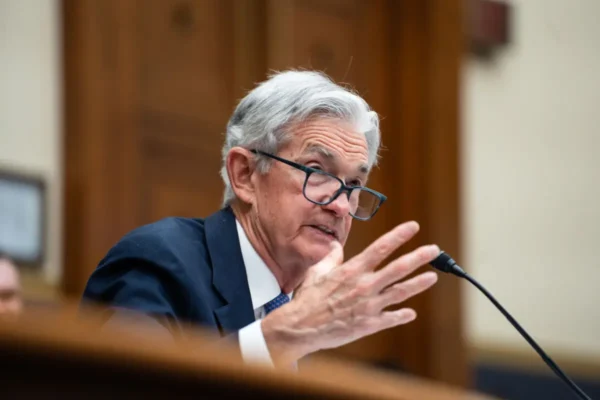
Economic observers have been analyzing the numbers to determine whether President Donald Trump’s tariffs are driving up consumer prices. Fed officials, writing in the minutes for the July Federal Open Market Committee policy meeting, say levies are seeping through the marketplace, and businesses have so far borne higher tariff-related costs.Appearing at the central bank’s Jackson Hole annual retreat, Fed Chair Jerome Powell stated that higher import duties are contributing to increased prices.
“The effects of tariffs on consumer prices are now clearly visible. We expect those effects to accumulate over coming months, with high uncertainty about timing and amounts.”
Whether tariffs will raise aggregate inflation this year and heading into 2026 remains to be seen. For months, economists and Fed policymakers have noted a lag effect in tariffs, meaning they will need to travel through the supply chain, distribution networks, contract pricing, and new inventories before having a material influence over business and consumer prices.
Meanwhile, despite concerns about tariff-fueled inflation, the U.S. central bank is widely expected to cut interest rates at the September meeting.
But the long-term picture is unclear, says Christian Hoffmann, head of fixed income and portfolio manager at Thornburg Investment Management.
“One to two cuts this year seem reasonable; five to six through the end of next year? I see a lot of risk around that number. That outcome assumes inflation is under control, the economy is steady, and the Fed can smooth things elegantly,” Hoffmann said in a note emailed to The Epoch Times.
Income and Spending
Personal incomes and spending advanced last month.New Bureau of Economic Analysis data show that personal incomes climbed by 0.4 percent, from 0.3 percent growth in June.
Compensation of employees was the most significant factor, increasing by 0.6 percent. Government transfer payments—such as Social Security, unemployment insurance, Medicare, and Medicaid—remained essentially unchanged.
Personal spending also advanced by 0.5 percent from an upwardly revised 0.4 percent gain, totaling $108.9 billion—$60.2 billion in services and $48.7 billion in goods.
July’s spending levels were driven by greater consumption of motor vehicles and parts, followed by financial services and insurance, housing and utilities, and food and beverages.
Both measurements were in line with the consensus estimate.
Market Reaction
The U.S. stock market headed into the Labor Day long weekend in the red.The blue-chip Dow Jones Industrial Average and the tech-heavy Nasdaq Composite Index each shed about 100 points before the opening bell. The broader S&P 500 fell by nearly 0.3 percent.
Yields for U.S. Treasury securities were mainly in the green. The two-year yield, which tracks Federal Reserve policy decisions, remained little changed at around 3.64 percent. The benchmark 10-year yield picked up 2 basis points to above 4.22 percent.
The U.S. dollar kept its early session gains intact, with the U.S. dollar index rising by nearly 0.3 percent. The index is poised for a weekly gain of 0.4 percent, slightly paring its year-to-date loss of 9.6 percent.