


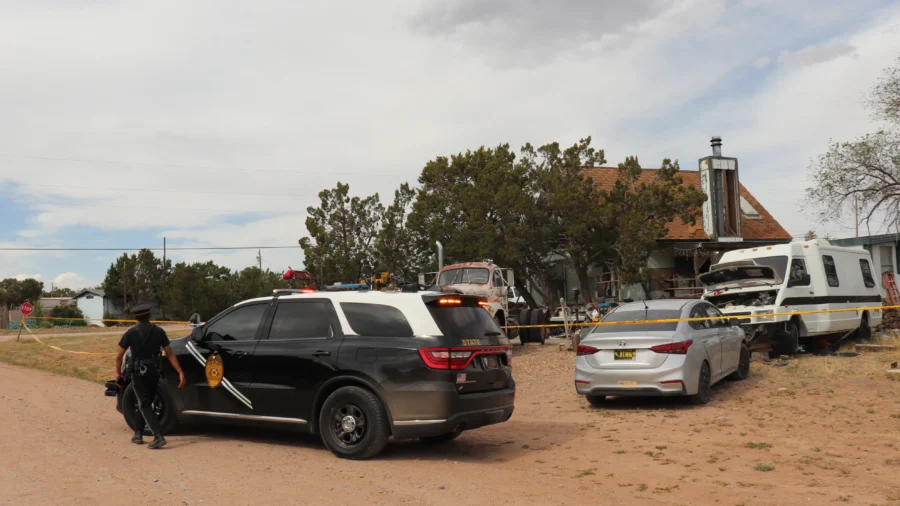
Fentanyl, methamphetamine, and a more potent synthetic opioid variant were found inside a rural New Mexico home after first responders who answered what had appeared to have been a routine overdose call were sickened by a powdered substance. Three people inside were also found dead.
The call came in just before 8 a.m. on Wednesday. First responders were dispatched to 306 Hanlon Ave. in Mountainair, a high-desert town of fewer than 1,000 people east of Albuquerque, according to New Mexico State Police. The initial report described a 60-year-old man who was unconscious but breathing—the kind of call these responders answer regularly.
Four people were found unresponsive inside the home. Three died. A fourth remained hospitalized on Friday. Within minutes of entering the home, first responders themselves began to feel the effects—nausea, dizziness, coughing, vomiting—as what was later identified as a powdered opioid substance took hold. In total, 25 people were exposed during the incident, according to New Mexico State Police Chief Matt Broom. Twenty have since been treated and released. Two remain hospitalized.
On-scene laboratory analysis by the DEA confirmed the presence of fentanyl, methamphetamine, and para-fluorofentanyl—also known as "Q4 fentanyl," a more illicit and potent variant of fentanyl—inside the home. Investigators did not immediately find evidence of drug manufacturing at the property.
Two of the three victims were identified on Friday as Mika Rascon, 51, and Georgia Rascon, 49. The identity of the third victim is being withheld pending confirmation through the Office of the Medical Investigator. The cause of death has not yet been determined.
The investigation was launched after a co-worker of one of those inside the home called authorities after they failed to show up to work.
The initial responders had no protective equipment when they entered. They spotted two victims, pulled them outside into fresh air and began resuscitation efforts, according to Torrance County Fire Chief Gary Smith.
"This did come in as an overdose. There was no indication of any type of hazmat type scenario," Smith said.
One person was revived using naloxone, the opioid overdose antidote. Less than an hour after the first call, dispatchers were relaying reports of multiple personnel exposures. More than a dozen first responders were then quarantined and decontaminated.
Mountainair Mayor Peter Nieto was among those who responded to the scene, drawn there over concerns the incident might involve a carbon monoxide or natural gas leak—the town operates its own natural gas system. Public works personnel ran two separate tests and checked meter readings. Natural gas was ruled out as a cause by around 8:12 a.m., according to Nieto.
Four Mountainair EMS workers were taken to the University of New Mexico Hospital for evaluation. Three were released later that afternoon. EMS Chief Josh Lewis remained overnight for observation and was discharged the following day.
"As of today, all Mountainair EMS personnel are home, resting, and feeling much better," Nieto said.
Albuquerque Fire Rescue dispatched 14 personnel, including a hazmat task force from Station 13, after receiving a mutual aid request. Crews entered the residence in Level B protective suits to sample unidentified substances, monitor the atmosphere, and remove one deceased individual, AFR Fire Chief Emily Jaramillo said during the conference. The hazmat team entered the hot zone at 3:06 p.m. and finished operations at 4:12 p.m.
UNM Hospital Chief Medical Officer Dr. Steve McLaughlin, who is also an emergency medicine physician, said the responders' symptoms most closely resembled fentanyl exposure. The hospital treated 23 patients connected to the event on Wednesday. One patient arrived at the hospital but died there.
McLaughlin stressed that while fentanyl is extraordinarily dangerous, the science around how it is transmitted is nuanced.
"It's probably not absorbed through your skin, but it would be absorbed through your eyes, nose, mucous membranes, or if you inhale it," McLaughlin said.
Authorities were operating "under the assumption" that fentanyl was responsible for the responders falling ill, he said, while noting that the investigation into how exactly they were exposed is ongoing.
New Mexico ranked fourth in the nation for drug overdose death rates in 2024, with 775 deaths recorded, according to the most recent data from the Centers for Disease Control and Prevention.