


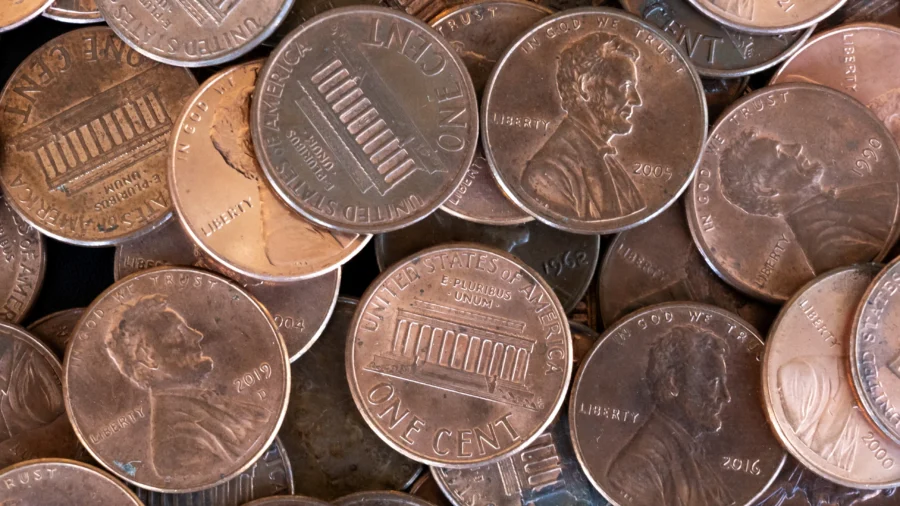
With President Donald Trump recently saying the U.S. penny costs more to produce than it is worth, the coin could be on the chopping block. Although it would take an act of Congress—and not an executive order—to close it out for good.
The administration’s new Department of Government Efficiency (DOGE) also weighed in on the issue, noting in a recent social media post the high cost of producing a single penny.
“The penny costs over 3 cents to make and cost US taxpayers over $179 million in FY2023,” it posted on X. “The Mint produced over 4.5 billion pennies in FY2023, around 40 percent of the 11.4 billion coins for circulation produced.”
Congress Calls the Shots
Penny production used roughly 2.5 percent of the total U.S. Mint budget for 2024, which stood at $3.385 billion. Even at $179 million, the annual cost of producing a penny is hardly more than a billionaire-worthy luxury yacht or a Palm Beach estate.Yet it’s enough cash to draw the attention of the White House, which seems keen on cutting the penny out of circulation.
That could be difficult as the penny’s fate lies in the hands of Congress, which holds authority over the U.S. Mint’s budget. The Federal Reserve could also have a say in the process, as it controls the U.S. currency and coin flow by ordering coins from the Mint every month, which it buys at face value.
Any direct attempt from the White House to cancel the penny may have to go through the courts if the Trump administration bypasses Congress.
If the United States does opt to cash out on the penny, it will hardly be the only country to do so. Canada axed the penny in 2012, and Australia, Brazil, Norway, Finland, and New Zealand have all halted production of low-denomination coins, primarily due to low demand and cost issues.
Opponents Say the Penny Isn’t the Real Cost Culprit
Not everyone is in favor of Uncle Sam canceling the penny.“The government won’t save money if the penny is eliminated,” said Mark Weller, executive director at the ACC in a statement. “Such a change would have a massive negative impact on the US Mint’s cost structure.
Citing “erroneous cost calculations” by DOGE, the ACC claimed the agency was bundling pennies with nickels in calculating the former’s production costs.
“This exaggerates the true cost of the penny and misrepresents the issue,” the organization stated in a release. “According to the U.S. Mint, while the penny’s production cost exceeds its face value, the real culprit for losses is the nickel, which costs nearly 14 cents per unit to produce.”
That scenario would present a problem for the Treasury Department.
Meanwhile, the Mint is making fewer coins than ever, keeping costs high given the agency’s fixed-cost coin production model.
“Total coin production dropped from 10.5 billion coins in 2023 to 5.9 billion coins in 2024—a 44 percent decline in just one year,” the ACC report noted. “Compared to four years ago, production is down 62 percent. Despite this, the Mint’s overhead costs remain relatively fixed, meaning these expenses are now spread across a much smaller pool of coins. This accounting approach inflates the reported cost of the penny and unfairly penalizes its production.”