



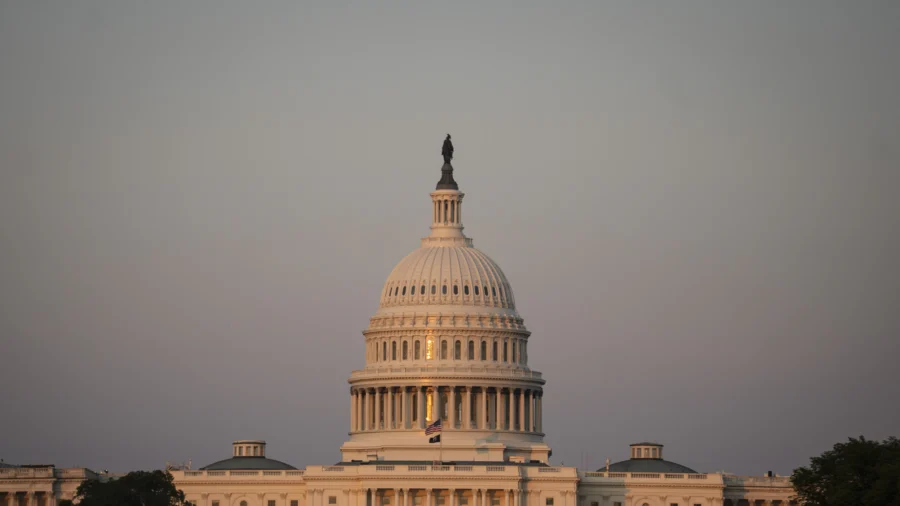
Republican leadership on May 21 canceled a scheduled vote on a war powers resolution that would block President Donald Trump from continuing military action in Iran.
“House Republicans have pulled the vote on [the war powers resolution],” House Minority Whip Katherine Clark (D-Mass.) wrote in an update for members posted on the application Dome Watch.It comes after a previous vote—related to the Smithsonian and women’s history—was held open for nearly an hour longer than scheduled. Often, when that happens, it’s because leadership expects that a bill might fail if brought to the floor.
Congress has fielded several such votes, and the Senate most recently passed a war powers resolution to block further action in Iran in a 50–47 vote.
A similar measure in the House failed last week on a 212–212 vote. Four Republicans and two Democrats did not vote.
On May 19, the Senate advanced a war powers measure to a final vote. Sen. Bill Cassidy (R-La.), who had opposed previous war powers legislation, joined three other Senate Republicans and 46 Senate Democrats in supporting this latest effort. Sen. John Fetterman (D-Penn.) joined most Republicans in opposition to the legislation, and Sens. John Cornyn (R-Texas), Thom Tillis (R-N.C.), and Tommy Tuberville (R-Ala.) were absent.
The legislation invokes the 1973 War Powers Resolution, which sets a time limit for a president to obtain congressional authorization to use military force, or otherwise remove U.S. forces from ongoing hostilities. It requires a president to remove U.S. forces from any hostilities lacking congressional authorization within 60 days. However, a president may extend that timeline by 30 days to enable a safe troop withdrawal.
Most presidents since its enactment have contended that the War Powers Resolution is unconstitutional but have generally adhered to its reporting requirements.
U.S. forces commenced offensive operations against Iran on Feb. 28. Washington and Tehran entered into a ceasefire on April 7, and Trump declared to Congress that the hostilities that began in February had terminated. However, U.S. forces have since exchanged fire with Iranian forces and are poised to resume large-scale combat operations.
The Republican majorities in the House and Senate successfully fended off several earlier attempts to limit U.S. military operations against Iran.
As the standoff has continued, however, more lawmakers on both sides of the aisle have started to join Democrat-led efforts to pass the war powers measure. Key absences have also narrowed the margins.
Trump has said the war against Iran is a preemptive action to prevent Iran, a terrorism-backing regime, from obtaining a nuclear weapon, while Iran has said it has a right to enrich uranium for its energy needs. U.S., European, and Israeli officials, for years, have said that Iran is working to enrich uranium to weapons-grade levels, while Tehran has disputed those assertions.
U.S. Vice President JD Vance on May 19 also reiterated that the Iranian regime cannot be allowed to develop a nuclear weapon, saying it would cause instability in the Middle East and potentially spark a worldwide nuclear conflict.
Iran has been found to have enriched its uranium to 60 percent purity, far exceeding the 3 percent to 5 percent needed for civilian nuclear power. Enriching uranium from 60 percent to the 90 percent needed for weapons-grade material can be done in a matter of weeks.