


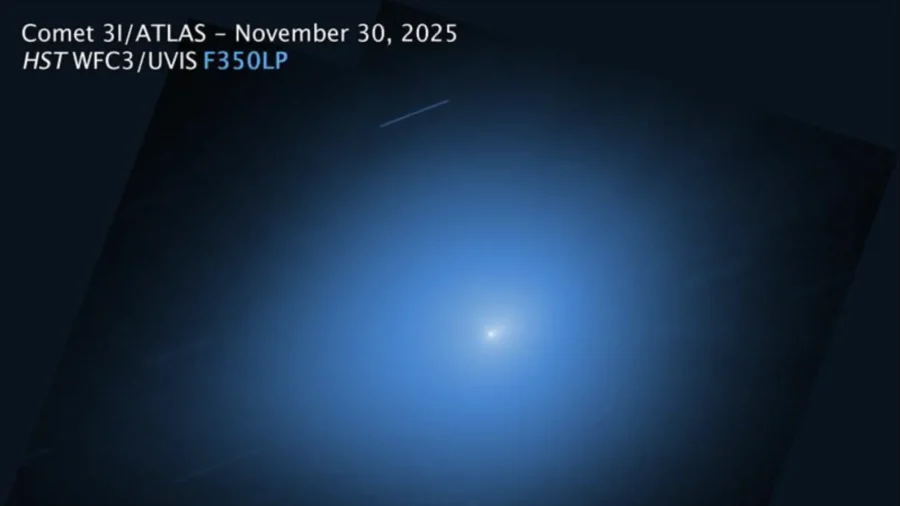
Comet 3I/ATLAS was first detected on July 1, 2025, by the Asteroid Terrestrial-impact Last Alert System (ATLAS) survey in Chile—a NASA-funded network dedicated to identifying near-Earth objects.
Its hyperbolic trajectory quickly revealed that it originated beyond our solar system, making it only the third confirmed interstellar object ever observed. The first two were 1I/‘Oumuamua in 2017 and 2I/Borisov in 2019, according to NASA.
Following its discovery, astronomers around the globe began tracking comet 3I/ATLAS with both space-based and ground-based observatories. On Nov. 30, NASA’s Hubble Space Telescope used its Wide Field Camera 3 to observe the comet as it traveled roughly 178 million miles, or 286 million kilometers, from Earth.
Hubble’s precise tracking of the comet’s movement caused background stars to blur into streaks—an imaging technique that allowed scientists to better determine the comet’s path and analyze the structure of its dust tail and surrounding coma.
NASA’s Europa Clipper spacecraft, currently on its journey to Jupiter, also contributed valuable observations. Its Ultraviolet Spectrograph, operated by the Southwest Research Institute, observed the comet in November at a time when Earth- and Mars-based telescopes were largely blocked by the Sun. This unique vantage point enabled scientists to study the comet’s dust and plasma tails from a rare sunward angle.
Europa Clipper’s data revealed the presence of oxygen, hydrogen, and dust-related features—clear signs that comet 3I/ATLAS underwent a period of heightened outgassing soon after its closest approach to the Sun on Oct. 30. According to scientists, these measurements help pinpoint the comet’s composition and provide valuable clues about the conditions of its formation.
After Friday’s flyby, comet 3I/ATLAS will journey farther out through the solar system. According to JPL projections, it will pass within about 33 million miles, or 53 million kilometers, of Jupiter in March 2026. Eventually, it is expected to leave our solar system altogether, returning to interstellar space.