



Consumers’ inflation outlook worsened this month as the war in Iran weighed on sentiment.
Global energy prices have surged since the start of the military conflict in Iran, causing pain at the pump—and the possibility of renewed inflationary pressures across the marketplace.
The University of Michigan’s March Consumer Sentiment Index, released on March 27, declined by 6 percent to its lowest level since December 2025.
The indexes for current economic conditions and consumer expectations slipped to 1.4 percent and 8.7 percent, respectively, from the previous month.
Weakening views of the economy were broad-based across age, income, and political party.
Middle- and high-income households with stock wealth "exhibited particularly large drops in sentiment," says Joanne Hsu, director of consumer surveys at the University of Michigan.
Consumers' short-term economic outlook declined by 14 percent, and year-ahead expected personal finances tumbled 10 percent. Long-run expectations, however, were tepid.
"These patterns suggest that, at this time, consumers may not expect recent negative developments to persist far into the future. These views are subject to change, however, if the Iran conflict becomes protracted or if higher energy prices pass through to overall inflation," Hsu stated.
While official wartime inflation data will not be released until later next month, businesses and consumers are feeling the pain of higher costs due to the conflict in the Middle East.
As of March 27, the national average for a gallon of gasoline is $3.98, according to the American Automobile Association.
Reading the Inflation Tea Leaves
More consumers anticipate a pickup in inflation over the next 12 months.The one-year inflation outlook rose to a higher-than-expected 3.8 percent from 3.4 percent in February. But the five-year inflation horizon dipped to 3.2 percent from 3.3 percent—in line with economists' expectations.
"The current reading exceeds those seen in 2024 and remains well above the 2.3-3.0% range seen in the two years pre-pandemic," Hsu noted.
Additionally, respondents surveyed after Feb. 28 reported higher inflation expectations than those surveyed before that date.
Looking ahead to the March Consumer Price Index report, the Cleveland Federal Reserve expects the annual inflation rate to reach 3.2 percent, from the current 2.4 percent.
The latest geopolitical strife has complicated both the economic and monetary policy outlook in the United States and elsewhere, says Lei Wang, portfolio manager at Thornburg Investment Management.
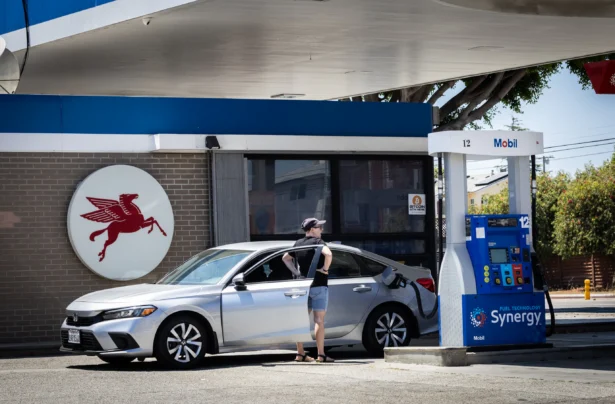
"Oil and gas prices have risen sharply enough to push headline inflation back up, and policymakers are clearly worried about the first-round energy impact and, no doubt, even more about second-round effects: wages, pricing behavior, and inflation expectations," Wang said to The Epoch Times in an emailed note.
This has created a situation in which the Federal Reserve and major central banks could consider raising interest rates or at least keeping them higher for longer.
Investors have trimmed their rate-hike expectations in recent days, anticipating that the Fed will not raise rates at all this year. According to CME FedWatch data, traders are pricing in the next quarter-point rate cut in September 2027—more than a year after Powell’s term ends.
Still, Wang notes, there is an argument for tightening policy in the current environment.
"After the 2022 inflation shock, central banks are more sensitive to the risk of appearing complacent if businesses pass through higher energy costs quickly," Wang said.
In addition, with progress on the path toward the Fed’s 2 percent target, it is imperative to prevent inflation expectations from edging higher, says Fed Governor Michael Barr.
"We have had five years now of inflation at elevated levels, and near-term inflation expectations have risen again, so I am particularly concerned that yet another price shock could increase longer-term inflation expectations," Barr said in a March 26 speech at the Brookings Institution.
"Consumers and businesses factor future inflation into their current economic decisions, so there is a risk that this dynamic could lead to inflation persistence, making it more difficult to return inflation to 2 percent."
But while government data indicate elevated price pressures, private-sector alternatives suggest inflation remains below the Fed’s 2 percent goal.
The Truflation US CPI Inflation Index—a real-time estimate that relies on a treasure trove of business and consumer data—sat at 1.78 percent as of March 27.