


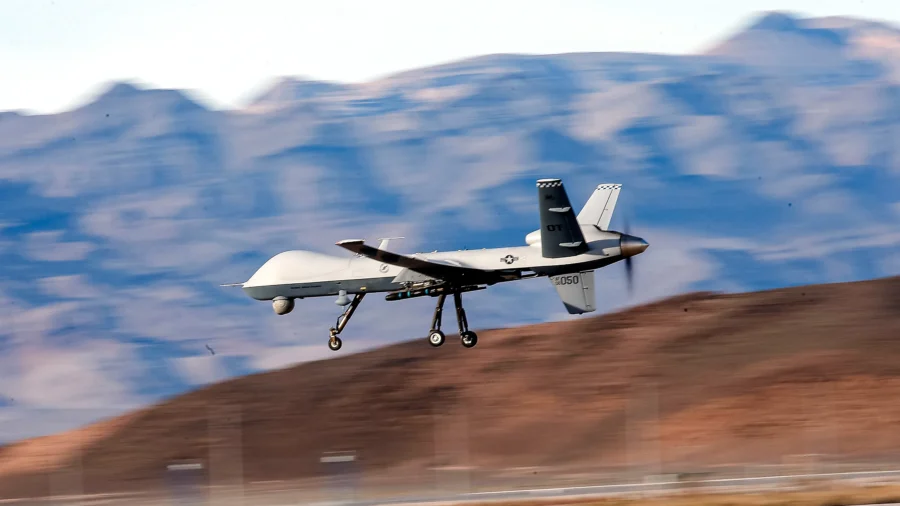
The Iranian military on May 26 said it downed a U.S. military drone over the Persian Gulf overnight as a spokesperson for the American command in the region confirmed new strikes.
Iran’s Islamic Revolutionary Guards Corps (IRGC) said it downed an MQ-9 Reaper drone and that the Iranian military also fired shots at an RQ-4 Global Hawk surveillance drone and a F-35 fighter jet, the IRGC said in a statement released by Iran’s state-owned broadcaster Press TV.
The U.S. military has not yet commented on the IRGC’s claims. An Epoch Times request for comment to the Pentagon was not immediately returned by publication time.
Strikes carried out by the U.S. military on May 25 were also condemned by the IRGC, which claimed they were part of the United States’ attempt at “interventionist adventurism and aggressive behavior in the region.” U.S. forces were able to enter Iranian airspace over the Persian Gulf, it added.
The U.S. military confirmed that it launched strikes on May 25 in southern Iran, where targets included missile launch sites, and characterized the attacks as defensive in nature.
“U.S. forces conducted self-defense strikes in southern Iran today to protect our troops from threats posed by Iranian forces,” U.S. Central Command spokesperson Tim Hawkins told media outlets on May 25. “U.S. Central Command continues to defend our forces while using restraint during the ongoing ceasefire.”
U.S. President Donald Trump said in a post on social media earlier on Monday that negotiations for a peace deal were “proceeding nicely,” a statement that was issued before the latest round of strikes.

Trump has also called on more Arab and Muslim states, including Saudi Arabia, to sign up to the Abraham Accords, a truce between Israel and Middle Eastern states brokered during his first term in office and aimed at normalizing ties between those states and Israel.
“I am mandatorily requesting that all Countries immediately sign the Abraham Accords, and that, if Iran signs its Agreement with me, as President of the United States of America, it would be an Honor to have them also be part of this unparalleled World Coalition,” Trump said in a post on Truth Social.

“The Enriched Uranium (Nuclear Dust!) will either be immediately turned over to the United States to be brought home and destroyed or, preferably, in conjunction and coordination with the Islamic Republic of Iran, destroyed in place or, at another acceptable location,” Trump wrote in a post on Truth Social.
He added that the destruction process would occur with the “Atomic Energy Commission, or its equivalent, being witness to this process and event.”
Trump has long said that Tehran cannot be able to obtain a nuclear weapon, saying that the war was launched on Feb. 28 against Iran to prevent the country’s regime from obtaining one.