


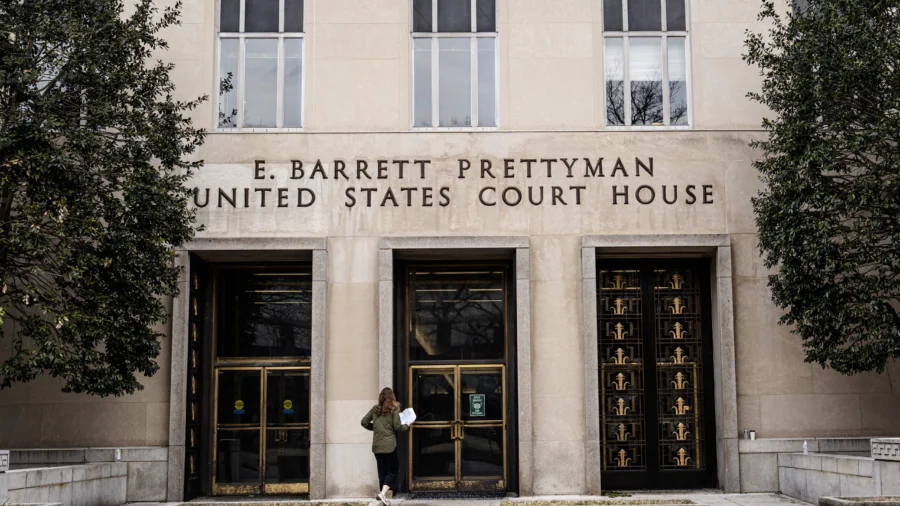
A federal judge on Feb. 2 ruled that the Trump administration could not end Temporary Protected Status (TPS) for Haitian nationals in the United States, affecting the government’s ability to deport them.
U.S. District Judge Ana C. Reyes held that the administration's decision to end the protected status for Haitians, through an order announced in November, violated federal law.
The decision prevents TPS for Haitians from ending on Feb. 3, the date it had been scheduled to terminate per the administration's order.
"[T]he Secretary did not consult [with other government agencies]. In terminating Haiti’s TPS designation without consulting, she acted contrary to law and in excess of statutory authority," Reyes wrote in an opinion published on Feb. 2.
Reyes also wrote that "President Trump has made—freely, at times even boastfully—several derogatory statements about Haitians and other nonwhite foreigners," which she said was evidence of discriminatory intent behind the decision that made it unlawful.
“Supreme Court, here we come. This is lawless activism that we will be vindicated on,” Assistant Secretary of Homeland Security Tricia McLaughlin wrote on social media in response to the decision. “Haiti’s TPS was granted following an earthquake that took place over 15 years ago, it was never intended to be a de facto amnesty program, yet that’s how previous administrations have used it for decades.”
“Temporary means temporary and the final word will not be from an activist judge legislating from the bench,” McLaughlin added.
The case was begun by several Haitian nationals who had received temporary status and sued the department on July 30 to prevent revocation.
More than 300,000 Haitians have received the designation and are presently in the United States, according to the National Immigration Forum.
The Haitians in the case argued that Homeland Security Secretary Kristi Noem's decision to end TPS for them was not in accordance with the facts of Haiti's present condition.
They wrote that such revocation violated the Administrative Procedure Act for being “arbitrary [and] capricious,” as well as violating the U.S. Constitution’s Fifth Amendment, which mandates that a person’s liberty cannot be deprived by the government without “due process of law.”
The Department of Homeland Security initially sought to terminate TPS for Haitian nationals on Sept. 2.
However, the department had to reissue the notice of termination, with a later date of Feb. 3, because of a federal district judge’s order in a separate case.
Feb. 3 is the date when protected status for Haitians was scheduled to end after it was extended by the Biden administration in July 2024.
"Disparate treatment based on nationality is permitted when it comes to the field of immigration," the Justice Department wrote in court filings in the case.
"The executive may decide to ‘antagonize a particular foreign country by focusing on that country’s nationals,’ and courts ‘[are] ill equipped to determine’ the authenticity or adequacy of those reasons," they added, referring to Supreme Court cases that bar courts from reviewing foreign policy decisions as "political questions."
The department then argued that the administration was justified in revoking TPS on the grounds of national interest.
In the separate case, the federal judge held that changing the date would unlawfully disrupt the lives of Haitian TPS recipients.
“[TPS recipients] ‘now have less than [three] months to organize transportation to Haiti; locate housing in which they can live upon their return; seek jobs with which they can support themselves after returning; arrange medical care to treat existing conditions and those they are likely to contract in Haiti; and secure reliable sources of food,” U.S. District Judge Brian Cogan wrote in an order in the separate case, which returned the date for any termination of TPS to no earlier than Feb. 3.
The Trump administration has defended its decision based on Haiti’s conditions.
“This decision restores integrity in our immigration system and ensures that Temporary Protective Status is actually temporary,” a spokesperson for the department wrote in a news release after the first revocation attempt, on June 27.
“The environmental situation in Haiti has improved enough that it is safe for Haitian citizens to return home," they added.
The Haitian TPS recipients who sued argued to the contrary, that Haiti remains too violent and unsafe for their return.
"Haiti is a nation in chaos. In the past several years, violent gangs have taken over Haiti, establishing a 'mafia-like model that is so entrenched the country can barely function without their consent,'" the Haitian plaintiffs wrote in their complaint.
Temporary protected status has been revoked for several countries during Trump’s second administration.
Many of these actions have been subject to challenges in federal court.
Under federal law, the Secretary of Homeland Security must periodically review country conditions to determine whether TPS holders can safely return to their countries of origin.