


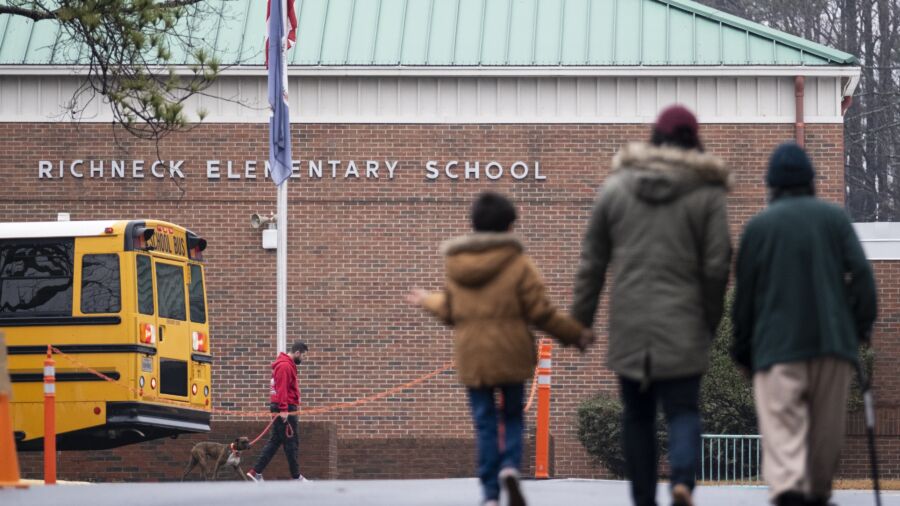
A judge in Virginia threw out the criminal case against the assistant principal accused of negligence in the shooting of a first-grade teacher.
Robinson began her remarks with a discussion of the "division of labor" in a criminal trial: the jury decides matters of fact, but the judge decides matters of law. She said the distinction between the two is not black and white, but finding it is critically important for determining questions of appellate review, how evidentiary rules are administered, and the application of precedent. It was at that point that she raised the issue.
Turning back to the prosecution's case, Robinson pointed out that the indictment lists students as the victims, but they do not list individuals. Moreover, she found that the prosecution's case was a "mashup of legal theory," and it was not clear that the facts of the case constituted crimes under the plain meaning of the statute.
According to the prosecution, at around 11:45 a.m. that day, first-grade teacher Abby Zwerner informed Parker that a student, "J.T.," was in a "violent mood." The student had a history of violent behavior. Other faculty members suspected that the student was carrying a gun; Parker searched the student's backpack, but he had already taken it out and was carrying it around on the playground. A counselor later asked for permission to search "J.T.'s" person, but Parker turned them down on the basis that his mother was arriving soon. The student later shot Zwerner in the chest; the student fled to another classroom while a reading specialist restrained "J.T." and called 911.
The prosecution laid out that Richneck had adopted an emergency management plan in which faculty were required to report situations to administrators, but only the administrators or a school security officer were allowed to take action; Richneck's security officer was at another school with whom he split time. So the only two people with authority to act were Parker and the school principal. But the principal was completely unaware of the situation until she heard the gunshot, because Parker had not informed her.
Robinson noted that the emergency management plan required two people to conduct a search of a student: either two administrators or an administrator and a school security officer. The school security officer was away, and the principal was in scheduled meetings during testing.
Furthermore, she concluded that the prosecution's case did not have a concise, relevant allegation that met the legal standard for "reckless disregard for human life."
"Is the crime that Dr. Parker didn't direct a search of the child's person after being informed that the bookbag was clear?" Robinson questioned. "Are the eight counts of the indictment based upon the number of children in the room when the firearm went off? Are the eight counts of the indictment based upon unfired bullets remaining in the firearm, which would be contrary to established case law as they have to be discharged? Is the delayed reunification the 'reckless disregard for human life?' Is it the emotional trauma of the exposed child who was in the classroom? ... Is it the fearfulness, bed-wetting, and hyper vigilance of all the children in school that day that comprises the 'reckless disregard for human life?' Is it because 'J.T.' wasn't expelled prior to January 6, 2023 due to his previous behaviors, which presumably would be in the province of the prior principals ... Or is the crime the lack of heightened response from Ebony Parker due to her awareness of prior issues with JT? The court is unclear."
Robinson said if the Virginia General Assembly wanted to make any of those allegations crimes, they would have to create specific statutory language that would codify it into law.
In the courtroom, Parker could be seen with her head in her hands, then audibly sobbing as the judge dismissed the case and recessed the courtroom.