


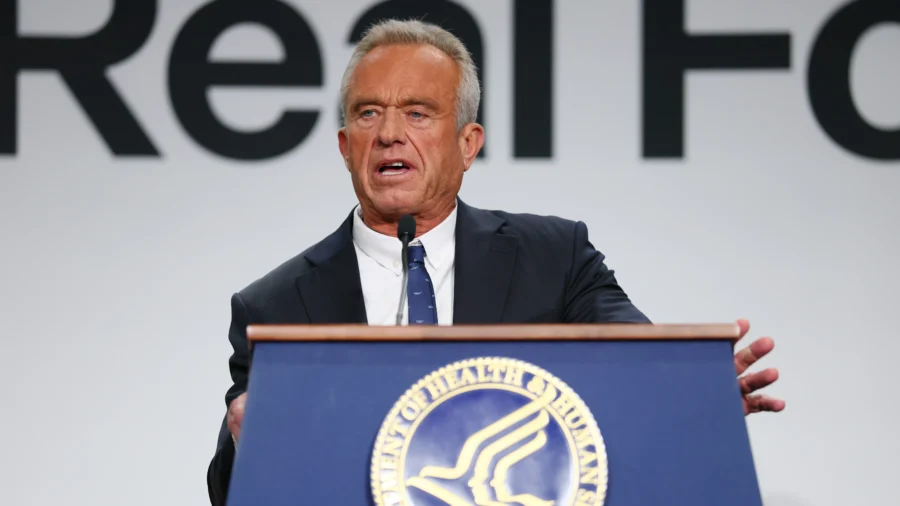
Health Secretary Robert F. Kennedy Jr. on April 9 issued a revised charter for a key vaccine advisory panel, expanding its role to emphasize vaccine safety risks and widening the criteria for membership selection.
The ACIP is a federal advisory committee that provides recommendations to the Centers for Disease Control and Prevention on the use of vaccines to control diseases and helps establish immunization schedules for children and adults in the United States.
In the updated charter, signed by Kennedy on March 31 and published on April 9, the panel’s tasks now include advising the CDC on “gaps in vaccine safety research including adverse effects following vaccination.”
The charter says the ACIP will consider the “cumulative effects of vaccines and their constituent components” and engage in “re-analysis of vaccine safety and efficacy” as gaps are identified.
The new charter broadens the membership criteria of potential panelists beyond those with expertise in the use and research of vaccines and immunization practices, specifically adding toxicology and data science.
It states that members "shall be selected from authorities who are knowledgeable in the fields of medicine, vaccines, immunization practices, immunology, toxicology, pediatric neurodevelopment, epidemiology, data science, statistical analysis, health economics, recovery from serious vaccine injuries, or public health; have expertise in the use of vaccines or other immunobiologic agents in clinical practice or preventive medicine, have expertise with clinical or laboratory vaccine research, or have expertise in assessment of vaccine safety and efficacy."
Ronald G. Nahass, president of the Infectious Diseases Society of America, said the revised charter appears to shift ACIP’s focus toward vaccine safety and adverse events, rather than maintaining its traditional approach that considered “the full scope of vaccine data.”
“These changes suggest that routine immunization is unsafe — adding to confusion and increasing vaccine hesitancy,” Nahass said in a statement, warning that the updated charter could lead to lower vaccine uptake.
The Department of Health and Human Services did not respond to a request for comment by the time of publication.
“First, of the fifteen members currently on ACIP, even under the most generous reading, only six appear to have any meaningful experience in vaccines—the very focus of ACIP,” the judge said.
Murphy said the new appointments also violated the Federal Advisory Committee Act, which mandates that members of such panels “maintain a fair balance on its committees and to avoid inappropriate influences by both the appointing authority and any special interest.”