

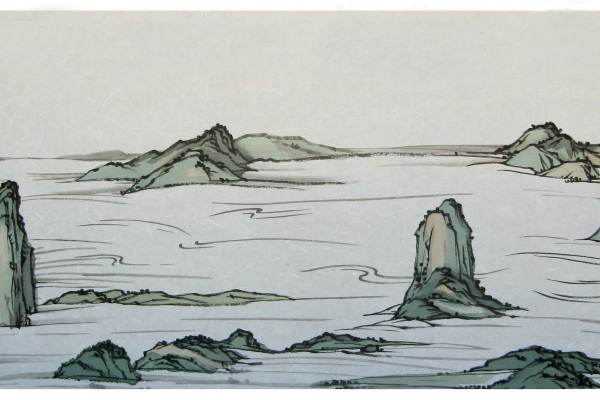
The “Classic of Mountains and Seas,” a series of legendary accounts compiled during the Warring States Period about 2,500 years ago, describes the Great Flood as a tremendous onslaught by waves and rain.
A great western sea overwhelmed the mountains of western China and Inner Mongolia. The waters forced their way into the Yellow River and the Chinese heartland. Fields and dwellings were submerged and destroyed. Masses of people and livestock found their graves in the bellies of fish.
The damage done to civilizations around the world was huge. Western legends describe the annihilation of existing culture, while records in the Chinese “Book of Documents,” traditionally attributed to Confucius, consider the Flood to be the dividing line between history and prehistory.
Yao Confronts the Disaster
In Yao’s day, China was divided into nine states. Around these lay the “four seas” and “eight desolations” beyond them. Annals from the 12th century record that Yao’s capital stood in Ji State.Faced with the disaster ravaging his empire, Yao searched for people who would be able to control the waters. Huan Dou, one of the unscrupulous ministers from before Yao’s ascension to the throne, recommended the minister of labor, Kong Ren.
The emperor was unimpressed and declared: “Kong Ren is a man of slick words. He is agreeable on the surface but obstinate behind the scenes. He may be superficially respectful and cautious, but he acts in opposition to the the Way and snubs the gods. He cannot be assigned to control the flood.”
Unfortunately, pointed out agricultural minister Hou Ji, no one else was available who had the skills to accept the task, so Yao was forced to appoint Kong to the position.
Later, Yao dispatched Hou Ji to pay visit to Mount Kunlun, where divine beings resided. There, he met the Lady Queen Mother of the West, who informed him that the Great Flood was an event brought about by the will of gods.
Simultaneously, the goddess explained, the keys to man’s salvation were also in divine hands. In twenty years’ time, she would return to personally assist the ruler fated to end the disaster.
In the enigmatic journey of heaven and earth, providence laid out a predestined fate.