


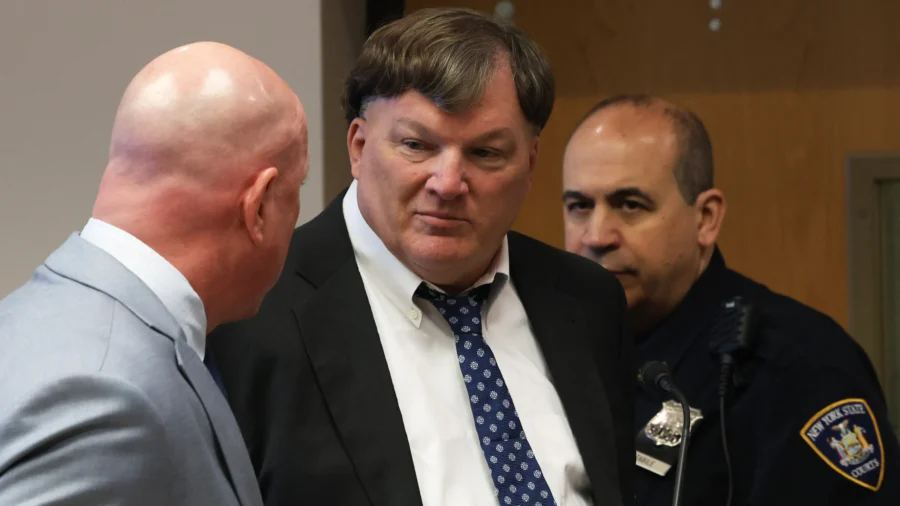
Long Island architect Rex Heuermann pleaded guilty Wednesday to murdering seven women and admitted killing an eighth in the Gilgo Beach serial killings.
In a packed Suffolk County courtroom, the 62-year-old quietly entered guilty pleas to three counts of first-degree murder and four counts of intentional murder. He also acknowledged killing Karen Vergata in 1996, though he was not charged in her death. He is to receive life in prison without the possibility of parole at a later date.
Authorities said Heuermann strangled the women, many of them sex workers, over 17 years and dumped their remains in remote areas, including along an isolated oceanfront highway near his Long Island home. The case, which began in 2010 after police discovered multiple sets of human remains along Long Island’s South Shore, drew worldwide attention, inspired a documentary series, and led to the 2020 Netflix film “Lost Girls.”
Suffolk County District Attorney Ray Tierney scheduled a news conference for later Wednesday with victims’ families and members of the Gilgo Beach Homicide Investigation Task Force, which ultimately broke the case using DNA from a discarded pizza crust. Investigators had tailed Heuermann in Manhattan, grabbed a box of partially eaten pizza he threw away, and matched DNA from the crust to a male hair recovered on burlap used to restrain one victim.
Detectives also relied on a vehicle registration database to link Heuermann to a pickup truck a witness reported seeing when one victim vanished in 2010. A grand jury then authorized more than 300 subpoenas and search warrants, letting investigators collect burner-phone billing records, re-test DNA from the crime scenes, and examine Heuermann’s internet history, which they said showed violent torture pornography and a fixation on the Gilgo Beach murders and the renewed probe. Cellphone data placed him in contact with several women just before they disappeared, investigators said.
After his 2023 arrest, detectives spent nearly two weeks searching his property and uncovered a basement vault holding 279 weapons. On his computer, investigators said they located so-called blueprints for the killings, including notes reminding him to limit noise, clean the bodies, and destroy evidence. A judge last year rejected his effort to keep out advanced DNA evidence that prosecutors argue proves he was the killer.
During Wednesday’s hearing, reporters and camera crews clustered around Heuermann’s ex-wife, Asa Ellerup, and their daughter as they entered the courthouse. “It’s a difficult day," said Robert Macedonio, Ellerup’s attorney. "No one can envision ever in their life standing here in a courthouse on a line surrounded by media, having their ex-husband accused of seven, potentially eight homicides. It’s unimaginable. There’s no way to prepare for it.”
In the courtroom, roughly half the seats were reserved for victims’ families and law enforcement officials. Wearing a black blazer and white shirt, Heuermann answered the prosecutor’s questions briefly as he confirmed he understood the charges and his guilty pleas, never turning to look at the gallery.
Before she was identified, investigators dubbed Jackson “Peaches” based on a tattoo, and she may have worked as a medical assistant. Jackson, who served in the Army from 1993 to 1995 in Texas, Georgia, and Missouri, had been estranged from her family and was not reported missing for some time.
Despite the proximity of the crime scenes, Nassau County authorities have been cautious about linking Jackson and her daughter’s killings to Heuermann. “Although Tanya and Tatiana have commonly been linked to the Gilgo Beach serial killings because the timing and locations of their recovered remains, we are not discounting the possibility that their cases are unrelated from that investigation,” Nassau Police Det. Capt. Stephen Fitzpatrick said about the case last year. “I’m not saying it is Rex Heuermann and I’m not saying it’s not. We are proceeding as if it’s not, keeping our eyes wide open.”
Nassau County District Attorney Anne Donnelly said advanced DNA and genealogy techniques were key to identifying the mother and child. “The reality is, our work has just begun,” Donnelly said. “Knowing the identities of the mom and the little baby is just a first step to help us get to solving these murders.” Jackson, who drove a black 1991 Geo Storm, was buried with full military honors alongside her daughter, while the toddler’s father is cooperating with investigators and is not considered a suspect.