


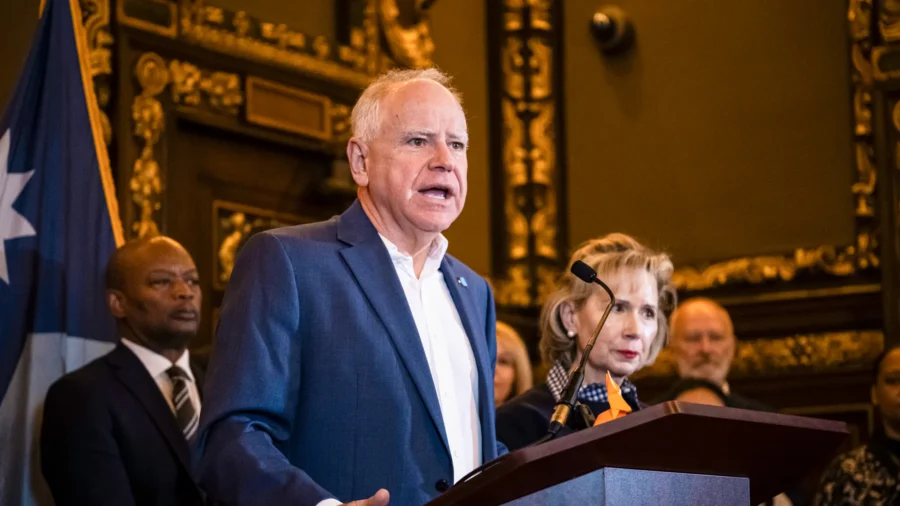
Minnesota Gov. Tim Walz on Thursday introduced a large anti-fraud legislative package aimed at strengthening the state's ability to prevent, detect, and prosecute fraud in public programs, one day after the Trump administration announced it would temporarily defer $259 million in federal Medicaid payments to the state.
The package includes the creation of a centralized Office of Inspector General, expanded authority for the Bureau of Criminal Apprehension's (BCA) Financial Crimes and Fraud Unit, a new Theft of Public Funds criminal statute that increases penalties by 20 percent, and the deployment of predictive analytics and machine learning to flag suspicious billing.
"Fraud steals from the people of Minnesota and undermines the programs we all rely on," the Democratic governor said in a news release. "This package strengthens oversight, improves detection, expands enforcement, and increases penalties to protect every dollar Minnesotans depend on."
State officials said the proposal builds on executive orders, new Minnesota Department of Human Services (DHS) leadership, and recommendations from Director of Program Integrity Tim O'Malley, whose 56-page roadmap released earlier this week found that vulnerabilities in Minnesota's fraud prevention systems date back to the 1970s.
Walz presented the package as bipartisan.
"Do you want to fix it or you want to talk about it?" Walz asked during a news conference on Thursday, directing his comments at Republican lawmakers. "Because it appears to me right now is that they fear fixing this because it takes away what they think is a political leverage."
Minnesota DHS Inspector General James Clark said at the news conference that his office had shut off payments to 540 Medicaid providers last year and made more than 300 referrals to law enforcement.
Minnesota DHS Commissioner Shireen Gandhi said the package would strengthen oversight of managed care organizations, which handle about 80 percent of Minnesota's Medicaid enrollees, and tighten controls on services for people with disabilities and older Minnesotans.
BCA Superintendent Drew Evans said the BCA's Financial Crimes and Fraud Unit is now the bureau's largest section. The package would expand the unit's subpoena authority, broaden the definition of identity theft to include misuse of a person's digital likeness, and extend the statute of limitations to seven years for crimes including securities fraud and theft by swindling.
"You will not escape simply because it takes a long time for us to investigate these cases," Evans said.
The proposal would also prohibit naming grantees in legislation, require a competitive award process, and make permanent the state's payment withholding authority, which currently expires in 2027.
The announcement comes amid widespread welfare fraud allegations in the state and escalating federal pressure.
Vice President JD Vance, who chairs the White House anti-fraud task force, said on Feb. 25 that the administration would defer $259 million in Medicaid payments to Minnesota until the state takes its "obligations seriously to stop the fraud."
John Connolly, Minnesota Medicaid director and Department of Human Services deputy commissioner, said the deferral applies to the fourth quarter of 2025, meaning the state must pay back that amount to the federal government. He said the action is separate from a $2 billion withholding communicated in a Jan. 6 letter, which the state has appealed.
"Our concern is that this could go on for several quarters, which would be catastrophic for the Medicaid program," Connolly said, citing potential impacts on children, seniors, hospitals, and nursing facilities.
Walz criticized the federal action as politically motivated, noting that Minnesota's Medicaid improper payment or error rate is 2.1 percent compared to a national average of 6.4 percent, according to what he described as CMS's own figures.
Asked about the capacity of the U.S. Attorney's Office in Minnesota, which has lost several attorneys, Evans said the departures have had a noticeable effect and that the BCA would turn to county attorneys to prosecute cases if the federal office lacks capacity.
Federal prosecutors have alleged that Medicaid fraud in the state could total as high as $9 billion since 2018. Connolly said the state has "no evidence to substantiate at this point a $9 billion figure."
Walz, who announced in January that he would not seek reelection, said the decision has freed him to focus on the issue without political considerations.
He said he has been asked to testify before a congressional committee and plans to discuss both the state's anti-fraud efforts and press for oversight of federal immigration operations in Minnesota that resulted in two deaths.
From The Epoch Times