

New Study Finds Southern California's Fault Systems at Highest Stress Level in 1,000 Years

Researchers from the University of Hawaii at Manoa said Southern California's San Andreas and San Jacinto fault systems appear 'critically stressed.'
Published: 6/17/2026, 3:25:23 PM EDT
New Study Finds Southern California's Fault Systems at Highest Stress Level in 1,000 Years
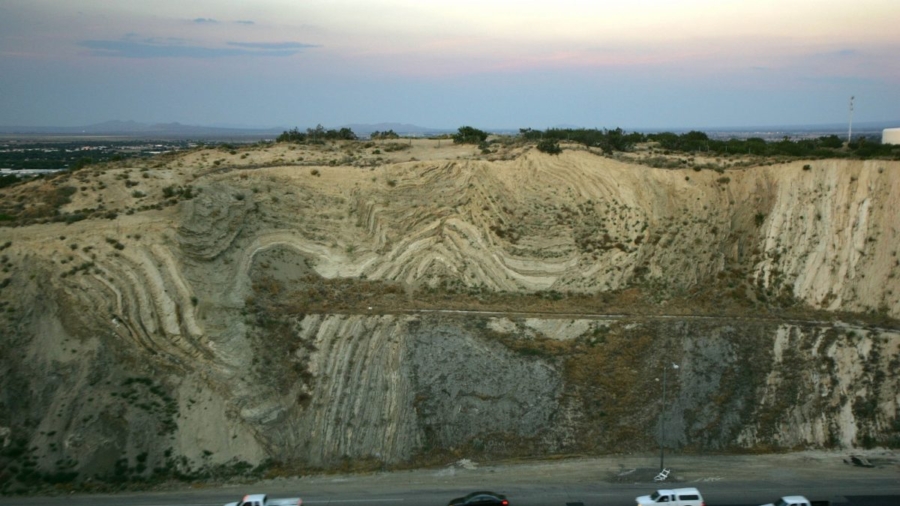
Layers of earthquake-twisted ground are seen at dusk where the 14 freeway crosses the San Andreas Fault in a 2006 file photo near Palmdale, California. (David McNew/Getty Images)

A new study has found that tectonic stress along Southern California's San Andreas and San Jacinto fault systems has reached levels not seen in at least 1,000 years.

According to research published earlier this month in the Journal of Geophysical Research: Solid Earth, scientists from the University of Hawaii at Manoa found that the fault systems are "critically stressed" and that, given the amount of time that has passed since they last ruptured, "the probability of an earthquake in the near future is high."
Researchers used a computer model to simulate how tectonic stress has accumulated and shifted over time along the San Andreas and San Jacinto fault systems, including near Cajon Pass, a corridor between the San Gabriel and San Bernardino Mountains that serves as an important junction between the two fault systems, the University of Hawaii shared in a news release.

Scientists input records of earthquakes gleaned from geological evidence over the past 1,000 years into the simulation, including radiocarbon dating and tree-ring data, to estimate how much stress the fault systems had developed.

The study's lead author, Liliane Burkhard, said in a statement that the results indicated that stress levels on several fault segments are now "at or above the highest values seen in the past millennium."

"The region may be capable of a large through-going rupture involving both fault systems," Burkhard added. "We also found that Cajon Pass may act as an 'earthquake gate': sometimes blocking large ruptures from crossing between the faults, and sometimes allowing them to pass through and involve both systems in a single event."

The Cajon Pass junction has previously been associated with several major earthquakes, including the 1812 Wrightwood earthquake. Research suggests the 7.5 magnitude event, also known as the San Juan Capistrano earthquake, ruptured across both fault systems near the mountain corridor. The 1857 Fort Tejon earthquake, estimated at a magnitude of 7.9, ruptured across more than 200 miles of the San Andreas Fault System, just north of Cajon Pass.

Despite the findings, Burkhard emphasized that the study was not a prediction of when an earthquake will occur in the future.

"However, studies like this are important contributions to national and global earthquake hazard research in that we are using rigorous, quantitative science to better understand the risk facing millions of people," Burkhard added.

"Physics-based models like this one give us a clearer picture of the range of scenarios we should be prepared for. That information matters for hazard assessments, infrastructure planning, and emergency preparedness."