


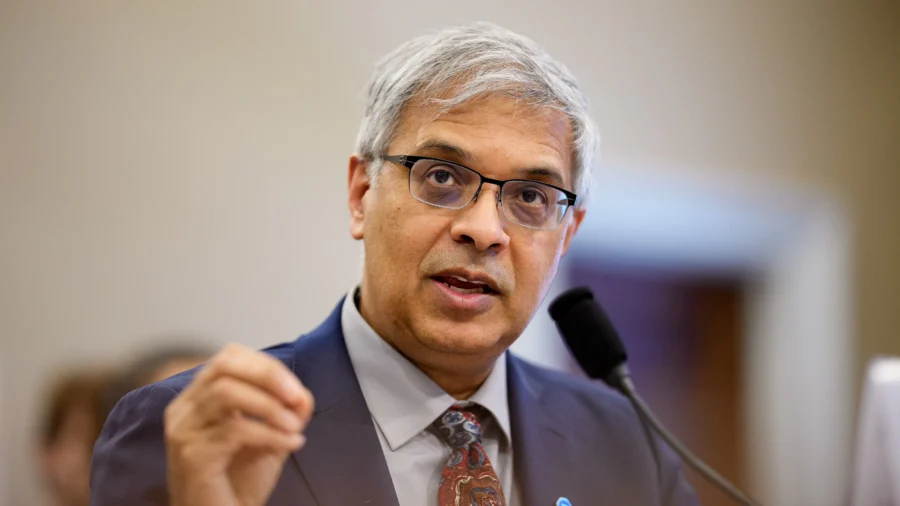
The National Institutes of Health (NIH) will soon start filling positions at its highest levels, NIH Director Dr. Jay Bhattacharya said on March 17.
NIH is made up of 27 institutes and centers. Sixteen currently have acting directors.
Rep. Rosa DeLauro (D-Conn.), the top Democrat on the House Appropriations Committee, said that the institutes that have acting directors have a combined annual budget of nearly $24 billion.
“This is one more example of the chaos and disarray that comes from the Trump administration,” she said in her opening statement, adding that the vacancies do not inspire confidence that health officials are working on behalf of the American people.
Bhattacharya said that there is a long process that takes place to vet people for the positions, and that the Trump administration has accelerated it.
Candidates are initially interviewed by NIH scientists, then career scientists in the Office of the Director. If they are advanced, Bhattacharya interviews them.
“My personal interview screen is, are they scientifically capable, do they demonstrate real leadership in their field, and do they have a vision, a passion for new ideas in their field?” Bhattacharya said.
Some members of the panel had expressed concern that political ideology was being used to evaluate possible center directors.
Bhattacharya said that he can only interview two to four candidates a week.
More Grants
Bhattacharya also said that he expects the NIH to start awarding more grants, after the White House budget office this week approved the NIH’s apportionment.“Scientists that are listening, don’t pay attention to the hype. We are in the process of identifying the excellent projects, the grants are going out the door,” he said.
DeLauro said she’s heard from researchers that grant funding has slowed to a trickle, leaving scientists wondering if they’ll receive money in time to continue their work.
The NIH awarded $35 billion in grants in fiscal year 2025, which ran through Sept. 30, 2025—the same figure as the prior two fiscal years.
However, in part because of a new policy of awarding multi-year grants, the number of awards declined by about 3,700, or 6 percent.
DeLauro said that the number of grants will keep going down if the process is not changed, and noted that the policy means that more applicants are rejected.
Bhattacharya defended multiyear grants and promised that grants are awarded based on two criteria: “scientific merit, and the potential to actually improve the health and wellbeing of the American people,” he said.
Rep. Robert Aderholt (R-Ala.), chairman of the House Appropriations Committee, praised Bhattacharya and developments under his leadership, including limiting the use of animals in testing.
“Bold actions under the Trump administration are making necessary reforms to grow and to build on biomedical infrastructure,” he said.