


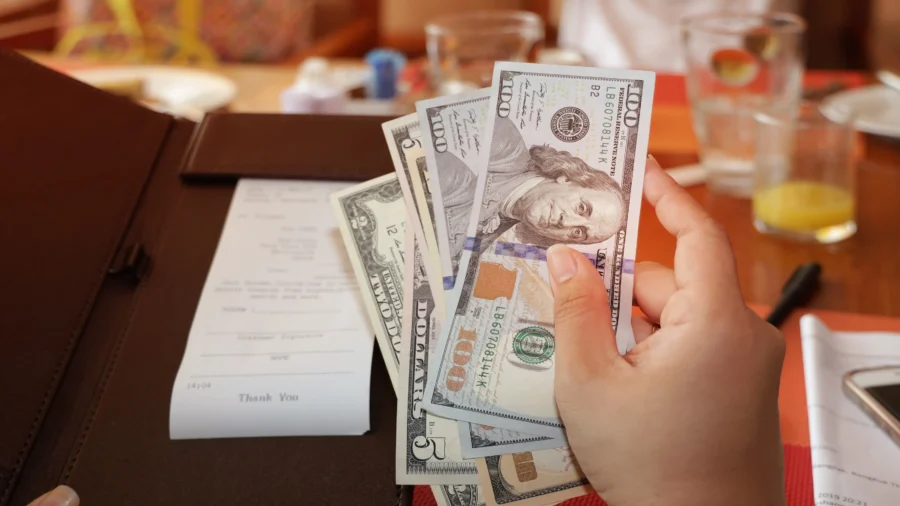
You received great service and want to reward your waiter. But your server may not be receiving the entire tip you left. Some restaurants and food establishments are quietly subsidizing their labor costs instead of letting workers keep their tips.
Tipped Employees Under the Fair Labor Standards Act
The Fair Labor Standards Act (FLSA), according to the Department of Labor, allows employers to take a tip credit toward their minimum wage and overtime obligations for tipped employees.Employers that claim a tip credit must ensure that the employee earns enough tips from customers and that the employee’s direct wages per work week equal at least the minimum wage and overtime compensation.
If an employee’s tips combined with employers’ direct wages don’t equal the $7.25 federal minimum hourly wage each workweek, the employer must make up the difference.
The maximum tip credit available is currently $5.12 per hour. This can ultimately subsidize labor costs because the employer would pay only $2.13 of the minimum wage, and your tip would make up the difference.
Credit Card Payments and Tips
Credit card companies require employers to pay a percentage of sales as a processing fee. Under the FLSA, the employer may pay the employee tips minus this percentage.For example, if a credit card company charges an employer 3 percent on all sales for its service, the employer may pay the tipped employee 97 percent of the tips without violating the FLSA.
Mandatory Service Charges on Large Party Bills
Often, when you are eating out with a large group, a mandatory 15 percent service charge is added to the total bill. The assumption is that this fee goes to the server. But this isn’t necessarily the case.A compulsory service charge is not considered a tip under the FLSA. But although they are not tips, they may be used to satisfy the employer’s minimum wage and overtime pay obligations. In other words, since they aren’t considered tips, the employer can use them however they want.
Sharing a Tip Pool
The FLSA allows employers to require employees to share or “pool” tips with eligible employees. This could be bussers, dishwashers, hosts or hostesses, or even chefs. In theory, it helps promote fairness since all these people enable good service.There are two kinds of tip pools. One is the “traditional” and the other is the “nontraditional.”
A traditional tip pool is when employees regularly receive tips. This could be servers, bussers, bartenders, etc. For this type of pool, the tip credit can be used.
A nontraditional tip pool is for everyone, regardless of whether they usually receive tips or not. This could apply to cooks or dishwashers. With a nontraditional pool, the tip credit cannot be used.
Individual States May Have Different Requirements
Often, state laws differ from the federal FLSA. In that case, the employer must comply with the standard most protective of the employee.Delivery Apps and Guaranteed Payout
Although it depends on employment status and state, delivery apps such as Grubhub and DoorDash can use a tip credit for their food delivery drivers.But, as mentioned, some states or districts don’t allow tip credit. One of these was Washington. In 2020, the district didn’t allow tip credit, and DoorDash found itself in hot water: it used customer tips to cover its guaranteed payout.
Tip Credit Reduces Restaurants’ Labor Costs
The tip you leave may not go entirely to your server. Restaurants and any other industry where employees are tipped can supplement employees’ pay through the tip credit.The views and opinions expressed are those of the authors. They are meant for general informational purposes only and should not be construed or interpreted as a recommendation or solicitation. NTD does not provide investment, tax, legal, financial planning, estate planning, or any other personal finance advice. NTD holds no liability for the accuracy or timeliness of the information provided.
From The Epoch Times