

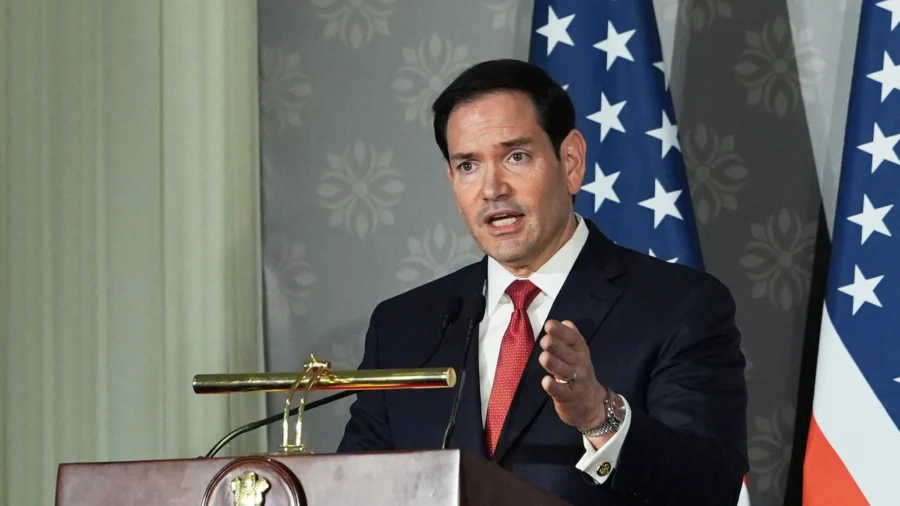
The United States has proposed a deal that would ensure the reopening of the Strait of Hormuz; however, Iran has yet to reply to the offer.
“We’re still a work in progress,” he said. “You’ve got to hear back, and it takes the Iranians—takes them a little while longer to get back.”
If secured, the deal would restore commerce throughout the international waterway and impose a time limit on negotiations regarding Iran's nuclear program as part of a new military operation called Project Freedom.
The Strait of Hormuz is bordered by Iran, Oman, and the United Arab Emirates (UAE).
“It has a lot of support in the Gulf,” Rubio said about the U.S. proposal. “There’s a lot of support globally. Every country that we’ve walked through it. Understand it’s not just very reasonable, but it’s the right thing for the world to get done.”
The goals of Project Freedom include providing 24-hour protection with a red, white, and blue dome over the Strait, enforcing the U.S. blockade, ending Iran’s tolling system, and preventing potential shortages of energy worldwide.
Pakistan is mediating and facilitating communication between U.S. and Iranian officials.
“The president said he’s not in a hurry,” Rubio added. “He’s not going to make a bad deal, and the president’s not going to make a bad agreement. So, let’s see what happens. We’re going to give diplomacy every chance to succeed before we explore the alternatives.”
Rubio also discussed challenges to maintaining a 45-day ceasefire between Israel and Lebanon.
He identified neither Israel nor Lebanon as obstacles to long-term peace, but rather a terrorist group and a political party.
“The problem is Hezbollah,” Rubio said. “Just last night, Hezbollah put out a statement calling for the overthrow of the Lebanese Government. It just reminds you of who we’re dealing with here.”
Hezbollah, based in Lebanon, is known to operate as a proxy of Iran. U.S. officials have classified Hezbollah as a terrorist organization.
“As long as Lebanon exists with armaments—as long as an armed Lebanon—as long as an armed Hezbollah exists, it’s going to be hard to achieve peace in Lebanon because they’re victimizing the people of Lebanon,” Rubio said. “They’re not just attacking Israel. They are victimizing the people of Lebanon, who are paying a tremendous price because of Hizballah.”
The Hezbollah terrorist group began firing at Israel on March 2 after the U.S. and Israel launched Epic Fury against Iran.