


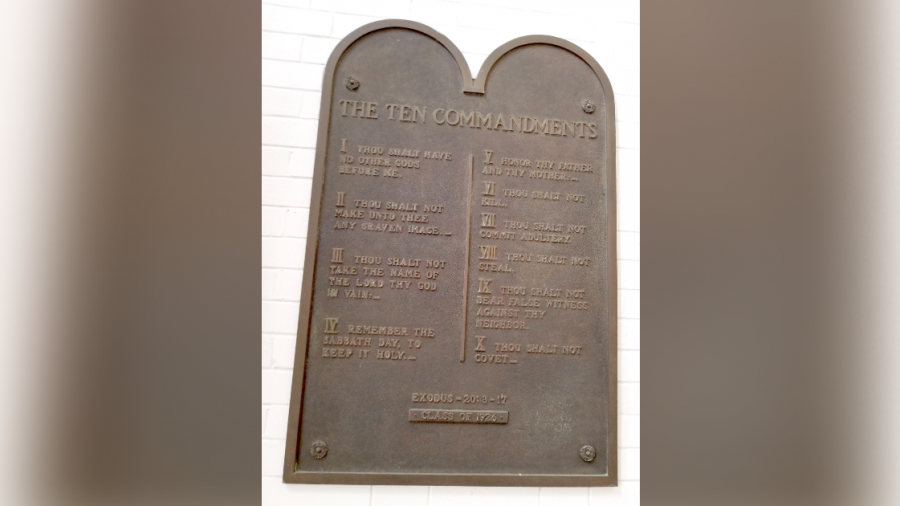
A middle school in Ohio removed a decades-old plaque that displays the Ten Commandments after a group called it a violation of the First Amendment.
The Joseph Welty Middle School in New Philadelphia installed the plaque on its grounds some 92 years ago, as a gift to the school’s district in 1927 from the class of 1926. But today the plaque is gone after the school received a complaint from the Freedom From Religion Foundation (FFRF).
“This plaque is a flagrant violation of the Establishment Clause of the First Amendment,” the FFRF said in its letter, and then proceeded to cite a past Supreme Court ruling—Stone v. Graham 1980—in which Ten Commandment displays in public schools were determined to be in violation of the Establishment Clause.
“The district’s promotion of the Judeo-Christian bible and religion over nonreligion impermissibly turns any non-Christian or nonbelieving student into an outsider,” FFRF’s attorney Christopher Line wrote in the letter.
“Schoolchildren already feel significant pressure to conform to their peers. They must not be subjected to similar pressure from their schools, especially on religious questions,” he added.
“As far as we’re concerned, this situation is completely resolved,” Line said on June 25, according to the news site. “We’re happy that the district did the right thing by taking down this religious promotion.”
FFRF Co-President Annie Laurie Gaylor commended the district for their speedy response.
“Students in our public schools are free to practice any religion they choose—or none at all. In America, we live under the First Amendment, not the Ten Commandments."
The district’s schools superintendent, David Brand, indicated that he did not agree with FFRF’s approach.
Brand said in a statement, cited by TimesReporter.com, that the plaque is recognized as “a part of the tradition and history of the New Philadelphia City Schools,” and noted that it had been on display for over 90 years.
He also wrote that to preserve the plaque would entail a number of hurdles that would require substantial costs that would divert time, energy, and manpower from the district’s true purpose which is to facilitate student learning, the news outlet reported.
The hurdles would include overturning a U.S. Supreme Court decision from 1980 and thereby becoming the first public school to successfully defend a Ten Commandments display in a school setting. Brand noted that if the District is unsuccessful “as all other school cases have been,” then the FFRF can seek for its legal fees to be covered, which could exceed $900,000.
He called the prospect of a legal challenge with the FFRF “an enormous risk and burden to the local taxpayers.” However, he said the district is considering to challenge the FFRF by filing an amicus brief.
“While members of the District do not agree with FFRF’s conduct, the District believes acting on its own terms is the most effective way to oppose FFRF and to continue to serve its students,” Brand wrote in his statement.
Dys told Fox News that Welty Middle School had taken down its Ten Commandments plaque around the same time that the Supreme Court had said that similar religious monuments were “presumptively constitutional.”
The Trump administration had also backed the American Legion in the litigation.