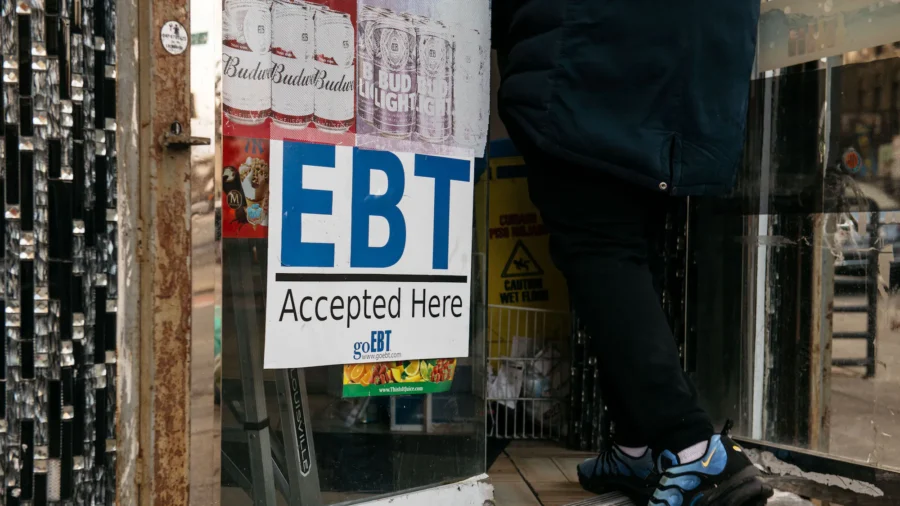
Tens of millions of low-income Americans face the possibility of missing their November food assistance payments as a federal government shutdown enters its fourth week with no resolution in sight.
The shutdown, which began Oct. 1 after Congress failed to approve a budget or temporary funding measure for fiscal year 2026, has put Supplemental Nutrition Assistance Program (SNAP) benefits at risk for more than 40 million people nationwide, according to the
Center for Budget and Policy Priorities, a left-leaning think tank. Among those who could lose assistance are approximately 16 million children, 8 million older adults, and 4 million people with disabilities.
While SNAP is classified as a mandatory program, its operation depends on congressional approval of funds. Without a budget or stopgap measure, the U.S. Department of Agriculture cannot distribute new benefits beyond those already funded.
USDA Secretary Brooke Rollins
warned on X that SNAP benefits would run out without a deal to reopen the government by November. She said the program is expected to run out of funding starting Nov. 1 for around 40 million people.
At least 36 states have issued warnings that November SNAP payments could be disrupted or delayed. The states include Alaska, Arkansas, California, Colorado, Connecticut, Delaware, Florida, Hawaii, Idaho, Illinois, Kansas, Kentucky, Louisiana, Maine, Maryland, Minnesota, Missouri, Montana, New Jersey, New York, North Carolina, North Dakota, Oklahoma, Oregon, Pennsylvania, Rhode Island, South Carolina, Tennessee, Texas, Utah, Vermont, Virginia, Washington, West Virginia, Wisconsin, and Wyoming.
Because SNAP operates through federal appropriations, all states will ultimately be impacted regardless of whether they have issued public warnings.
Texas officials
stated that residents will not receive November SNAP benefits if the shutdown continues past Oct. 27.
Minnesota and
Pennsylvania have similarly warned recipients that November benefits will not be issued if the shutdown persists.
The West Virginia Department of Human Services said in an Oct. 18 Facebook
post that the USDA's Agriculture Food and Nutrition Service directed the state to delay October benefits approved on or after Oct. 16. The agency added that it is "very likely" the shutdown would delay November SNAP benefits for all recipients if Congress does not take action to reopen the government "in the coming days."
Louisiana officials announced that SNAP benefits will not be issued to recipients starting Nov. 1, the Louisiana Department of Health said in a Thursday
press release. The state currently serves 792,769 residents in 396,157 households through the program.
The warnings from states have taken on partisan tones, with officials from both parties blaming the opposing side for the impasse.
Louisiana Governor Jeff Landry, a Republican, said that: "The U.S. House under Speaker Mike Johnson of Louisiana has already acted to re-open the government. Our U.S. Senators representing Louisiana have voted over and over again to re-open the government,” he stated in a recent
press release. “They are doing their part. Now it is time for those U.S. Senators, voting under Democrat Senate Leader Chuck Schumer, to vote yes and re-open the federal government."
Rhode Island Gov. Dan McKee, a Democrat, countered: "President [Donald] Trump and congressional Republicans began this shutdown by playing political games with health coverage for millions of Americans. Now, their ongoing inaction is threatening crucial food assistance for those who need it most."
Rep. Gabe Amo (D-R.I.)
said during an Oct. 20 tour of the Rhode Island Community Food Bank: "Republicans ran on lowering costs, instead their Big, Ugly Law assaults food and health programs on which Americans' rely. And now, this Republican shutdown is risking Rhode Islanders ability to put food on the table as we head into the holiday season."
Rollins pinned blame on Democratic lawmakers, stating: "Democrats are putting free healthcare for illegal aliens and their political agenda ahead of food security for American families."
The funding impasse centers on Democratic demands that any government funding bill include an extension of subsidies for health insurance purchased through the federal marketplace. Advancing a funding bill in the Senate requires 60 votes, meaning Democratic support is necessary.
Senate Minority Leader Chuck Schumer
told CNN that Democrats have no plans to change their strategy despite SNAP funding running out, saying: "No it should change Republican calculus. They should sit down and negotiate a way to address this crisis. They caused it, they're the ones maintaining it."
Several states have announced emergency measures to provide temporary assistance. Colorado Governor Jared Polis, a Democrat, announced up to $10 million in emergency food bank support for the period when SNAP benefits might be unavailable.
Hawaii Gov. Josh Green, a Democrat, authorized $100 million from the Temporary Assistance for Needy Families program to support SNAP recipients. "My program will give us probably about a two-month cushion, and we will give everyone details on how to apply for that, how to make sure they get these monies if they are in real dire straits, but that can't go on forever, and I'm really hoping, praying, and I'm going to put some pressure of my own in D.C. on the folks that make these decisions," Green told
Hawaii News Now.
Kansas Department for Children and Families Secretary Laura Howard
said that once an agreement is reached or alternative funding is secured, benefits could be available within 72 hours. "As soon as an agreement is reached or the federal government finds an alternative funding source, and DCF receives approval from FNS, we are prepared to act quickly with contracting partners to get benefits out to Kansans," Howard said.
The USDA told state agencies in an Oct. 10 letter not to send certain files to contractors that would allow benefits to be loaded onto Electronic Benefits Transfer cards at the start of November, according to EBT processor Conduent, which works with 37 states.
The shutdown, now the second longest in U.S. history, has furloughed approximately 750,000 of the federal government's nearly 2.3 million civilian employees, according to Congressional Budget Office estimates.