


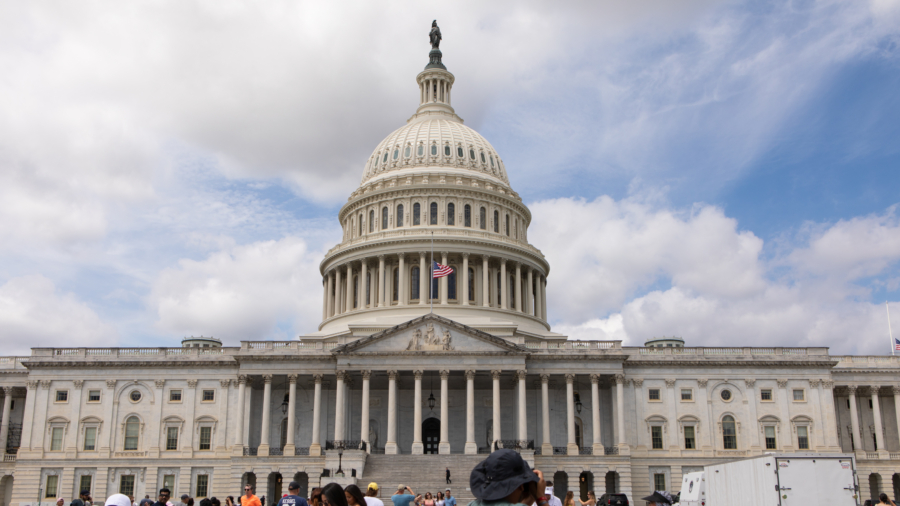
The Senate voted Sunday afternoon to pass the Democrats' sweeping health care and climate bill in a 51–50 vote, with Vice President Kamala Harris casting the tie-breaking vote.
The estimated $740 billion package will go to the House now.
“It’s been a long, tough and winding road, but at last, at last we have arrived,” said Senate Majority Leader Chuck Schumer (D-N.Y.) said Sunday. “The Senate is making history. I am confident the Inflation Reduction Act will endure as one of the defining legislative measures of the 21st century.”
Senators engaged in a round-the-clock marathon of voting that began Saturday and stretched late into Sunday afternoon. Democrats voted against some three dozen Republican amendments designed to torpedo the legislation.
The bill ran into trouble midday over objections to the new 15 percent corporate minimum tax that private equity firms and other industries disliked, forcing last-minute changes.
"It will close tax loopholes and it will reduce and reduce the deficit," Schumer claimed. "It will help every citizen in this country and make America a much better place."
Americans for Tax Reform (ATR), a U.S. advocacy group, stated that the measure will increase taxes on thousands of mid-sized small businesses across the United States.
Concerns over objections to that 15 percent corporate minimum tax on private equity firms and other industries threatened to slow the progress.
Sen. John Thune, of South Dakota, the second-ranking Republican, was working on an amendment that would strip the tax for certain sectors. He was trying to draw support from Sens. Kyrsten Sinema (D-Ariz.) and Joe Manchin (D-W.Va.), two holdouts who have bucked their party before.
Thune predicted several more hours of negotiations and debate. “Hopefully we’ll have a solution to land the plane,” he told reporters at the Capitol.
Republicans said the measure would undermine an economy that policymakers are struggling to keep from plummeting into recession. They said the bill's business taxes would hurt job creation and force prices skyward, making it harder for people to cope with the nation's worst inflation since the 1980s."Democrats have already robbed American families once through inflation, and now their solution is to rob American families a second time," Senate Minority Leader Mitch McConnell (R-Ky.) said on the floor.
Spending and tax increases in the legislation would eliminate jobs while having an insignificant impact on inflation and climate change, the Kentucky Republican leader said.
More Details
The bill came to the floor about a week after Manchin announced he came to an agreement with Schumer in what is believed to be an attempt to boost Democrats' and Biden's chances during the 2022 midterms amid months of negative polling. Biden’s original climate and social measure collapsed after Manchin opposed it, saying it was too costly and would fuel inflation."The Inflation Reduction Act is the product of years of bipartisan conversations about the most impactful ways to produce more energy domestically, bring down energy and healthcare costs and pay down our debt. The IRA achieves this without raising taxes," Manchin wrote on Twitter.
Around the same time, the West Virginia Democrat said he would vote down GOP amendments.
But left-wing Sen. Bernie Sanders (I-Vt.) offered amendments to further expand the legislation’s health benefits, and those efforts were defeated. Most votes were forced by Republicans and many were designed to make Democrats look soft on U.S.–Mexico border security and gasoline and energy costs, and like bullies for wanting to strengthen IRS tax law enforcement.
Late Saturday, Sanders said the measure won't reduce inflation and said it also doesn't go far enough with its climate-related measures.
"I want to take a moment to say a few words about the so-called Inflation Reduction Act' that we are debating this evening," Sanders said from the Senate floor. "And I say so-called, by the way, because according to the [Congressional Budget Office], and other economic organizations that study this bill, it will, in fact, have a minimal impact on inflation."
Sanders added: "At a time when the drug companies are enjoying huge profits, the pharmaceutical industry will still be allowed to charge the American people by far the highest prices in the world for prescription drugs."