


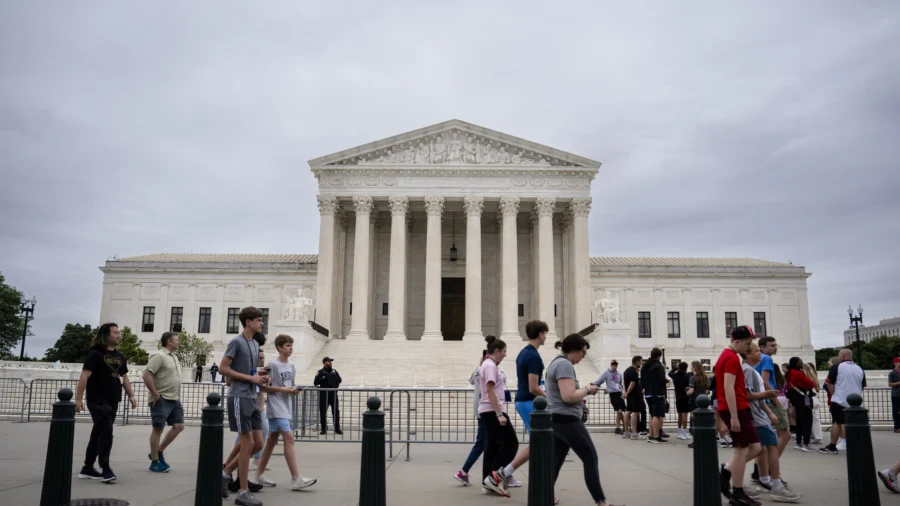
The U.S. Supreme Court on May 26 sided with the Trump administration in a lawsuit federal immigration judges brought that challenges a federal government policy limiting the judges’ public statements about their jobs.
The nation’s highest court ruled that a federal appeals court violated an important legal principle by ruling on legal issues that the parties themselves had not presented.
The Supreme Court issued a narrow, procedural ruling that did not weigh in on the lawfulness of the restrictive speech policy itself, which remains in effect for the time being.
The justices reversed the judgment of the U.S. Court of Appeals for the Fourth Circuit and sent the case back to that court for “further proceedings consistent with this opinion.”
The National Association of Immigration Judges sued the federal government over its 2021 speaking engagements policy that required immigration judges to obtain a supervisor’s permission to speak at public events. This policy of the Executive Office for Immigration Review, which administers the immigration court system, was intended to make sure that employees’ speech that may be seen as representing official positions taken by the office is in fact consistent with those positions.
The association claimed that the policy constitutes a prior restraint on its members’ speech in violation of the Constitution’s First Amendment.
In September 2023, the U.S. District Court for the Eastern District of Virginia ruled against the association, holding that the federal Civil Service Reform Act (CSRA) deprives the court of jurisdiction, or authority, over the lawsuit.
The district court dismissed the lawsuit, finding that the dispute must first be adjudicated under the administrative review scheme laid down by the CSRA before it can move to the courts. This means that the dispute should be heard by the Merit Systems Protection Board (MSPB) because it pertains to a challenge to a condition of federal employment.
The board describes itself on its website as “an independent, quasi-judicial agency in the Executive branch that serves as the guardian of Federal merit systems.” This means that the board tries to ensure that federal hiring should be based on merit. The MSPB also reviews rules handed down by the Office of Personnel Management, which oversees federal employees.
In June 2025, a three-judge panel of the Fourth Circuit unanimously overturned the district court’s ruling.
The panel returned the case to the district court after finding that President Donald Trump’s firing of leaders at the MSPB and the Office of Special Counsel had “so undermined” the statute that federal workers could not seek meaningful review in disputes.
The panel on its own initiative directed the district court to develop “a factual record” assessing the “functionality” of the Civil Service Reform Act in light of Trump administration actions.
Congress passed the CSRA to deprive district courts of jurisdiction to review legal challenges such as those raised by the association, but the structure of the Act “relies fundamentally … on a strong and independent MSPB and Special Counsel,” according to the panel.
“Serious questions have recently arisen regarding the functioning of both the MSPB and the Special Counsel,” the panel stated.
“We cannot allow our black robes to insulate us from taking notice of items in the public record, including, relevant here, circumstances that may have undermined the functioning of the CSRA’s adjudicatory scheme.”
The Trump administration appealed the Fourth Circuit’s decision, arguing it should not have ordered the district court to engage in a fact-finding exercise on issues that were not addressed by the litigants.
In its new ruling, the Supreme Court recounted that the district court found the association’s challenge must go through the administrative scheme provided in the CSRA.
Yet the Fourth Circuit vacated the case and sent it back to the district court based on an issue the parties had not raised in the litigation. “That decision violated the principle of party presentation, and we reverse,” the high court said.
The principle of party presentation is an important part of the adversarial legal system. It provides that courts generally must rely on the parties to frame the issues for decision and serve as neutral arbiters, instead of independently raising or deciding new issues on their own.
The justices said that Congress intended for federal employees to file most work-related grievances with the MSPB, not with federal district courts. The district court had dismissed the association’s claims and found they were covered by the CSRA, they said.
The Fourth Circuit vacated the district court’s decision but also held that the claims were covered by the CSRA and that district courts could not hear such claims. At the same time, the appeals court called into question whether the act was “functioning as Congress intended” because legal challenges to MSPB members’ tenure protection and other issues may require a “new examination of Congressional intent” to steer claims away from district courts.
The Supreme Court said that by deciding a case other than what the parties argued, the Fourth Circuit ran afoul of the party presentation principle. Quoting prior legal precedents, the high court said federal courts are not supposed to be “roving commissions” that “sally forth each day looking for wrongs to right.”
“The Court of Appeals lost sight of those principles here,” the Supreme Court said.
Justice Clarence Thomas filed a concurring opinion, which Justice Amy Coney Barrett joined.
“The Fourth Circuit’s analysis bears little resemblance to legal interpretation,” Thomas wrote.
Neither the president’s view that he may remove federal executive officials, nor the fact that he has done so, “change the meaning of the statute or the binding nature of this Court’s interpretation of it.”
Acting U.S Attorney General Todd Blanche hailed the new ruling.
As the U.S. Department of Justice had argued, the Fourth Circuit “was wrong to try to rewrite a statute about the process for resolving government employee complaints,” Blanche said in a post on X.
“Judges should be judges resolving the case before them, and should never try to seize Congress’s role,” he said.
The National Association of Immigration Judges said it was disappointed by the new ruling, which fails “to address the significant free speech concerns at the heart of this case.”
“However, this litigation is far from over,” the association told The Epoch Times.
“Justice cannot endure when judges are intimidated into silence, nor can a nation remain free when the rule of law is subordinate to the whims of political ambition.”