


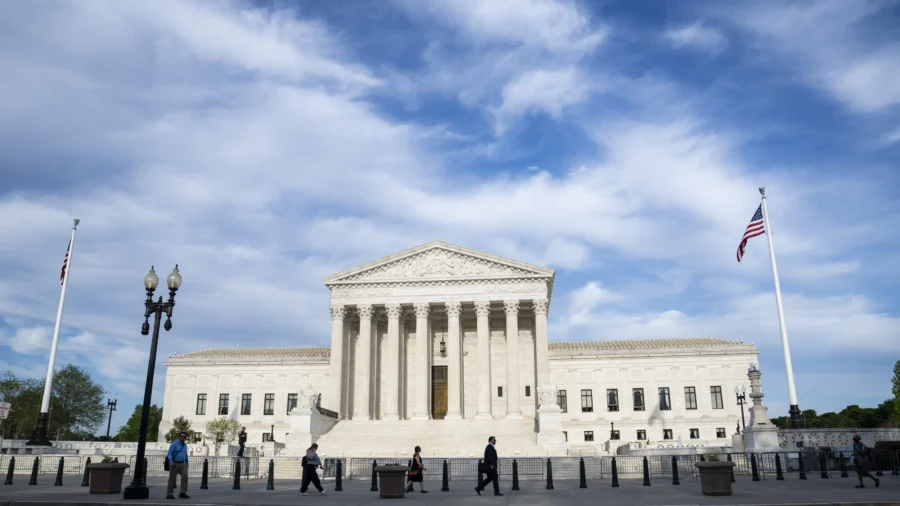
Supreme Court justices on April 20 declined to take up a case involving a Massachusetts schoolgirl whose parents say officials wrongly hid their daughter's purported identity as a male from them.
The vote count on the petition and how each justice voted were not disclosed, nor were any comments offered by the justices.
“Today’s denial by the Supreme Court is a missed opportunity to defend parental rights," Jim Campbell, chief legal counsel at Alliance Defending Freedom, who was helping represent the parents, told The Epoch Times in an email.
"Social transition, including going by inaccurate or nonbinary pronouns and a different name, is a major intervention in a child’s life that puts the child on a difficult-to-escape pathway to medicalized transition, carrying the risk of life-altering damage. No school district should make important mental health decisions on behalf of parents and conceal those decisions from them, especially in opposition to the mental-health care that those parents have chosen for their children."
An attorney representing the school officials did not return a request for comment by the time of publication.
The parents said that Ludlow Public Schools secretly encouraged students to state their gender identity and, through other measures, promoted transgenerism. Officials facilitated the purported transition of their daughter, who is referred to as B.F. in court papers, to male, or "nonbinary," without letting her parents know, according to court documents.
"That led B.F. to question the suitability of her parents’ care plan—all without her parents’ knowledge. After discovering the school’s actions, Petitioners demanded that officials stop. But the school doubled down, claiming parental knowledge and involvement compromises their daughter’s safety."
The parents said that what happened violated their constitutional rights.
A district court judge dismissed the case, ruling that the evidence did not show that school officials usurped the rights of the parents by referring to B.F. with preferred names and pronouns. While it was "disconcerting" that officials did not disclose information to the parents, that choice was consistent with state law, the judge said.
A federal appeals court upheld that decision.
"In this litigation, the competing concerns of the Parents and Ludlow raise heretofore unanswered questions about the scope of parental rights protected by the Due Process Clause of the Fourteenth Amendment," it stated. "But when all is said and done, we, like the district court, conclude that the Parents have failed to state a plausible claim that Ludlow’s implementation of the Protocol as applied to their family violated their fundamental right to direct the upbringing of their child."
School officials told the Supreme Court that it should not take up the case because it did not actually have a policy to hide gender identity transition information from parents.