

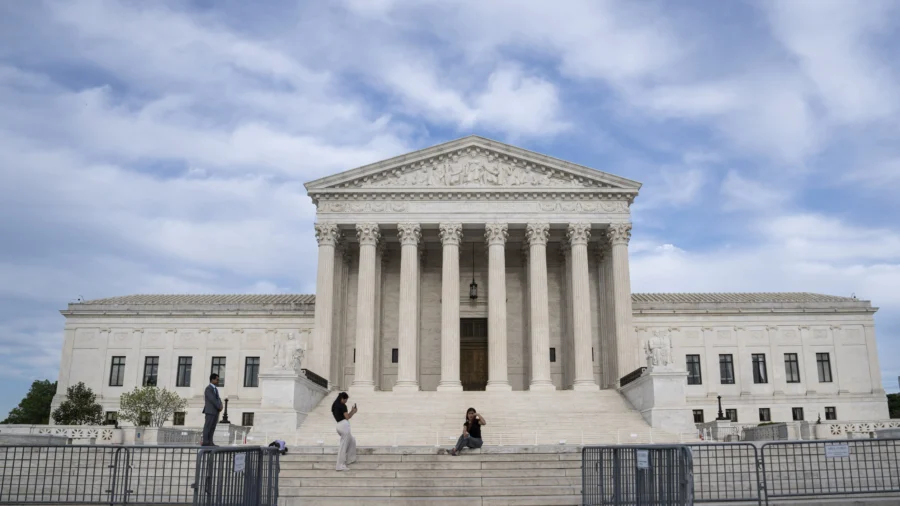
The Supreme Court on April 21 seemed poised to rein in the Federal Communications Commission’s (FCC) power to levy large fines through its in-house adjudication system.
In the cases of FCC v. AT&T and Verizon Communications v. FCC, which were heard together, the telecommunications companies argued that provisions in the federal Communications Act of 1934 are unconstitutional. The statute that allows the FCC to use in-house adjudications to impose penalties without going to court violates the Seventh Amendment right to a jury trial in federal civil cases, the companies say.
The Department of Justice (DOJ) said the so-called forfeiture orders requiring payment prior to a trial do not violate the Seventh Amendment because there is no legal obligation for companies to pay the fines until they have been adjudicated by a duly appointed federal judge.
The cases arose after the FCC ordered AT&T and Verizon to pay $57 million and almost $47 million, respectively, for allegedly sharing customer location data with third parties without consent, a violation of the federal Telecommunications Act.
The dispute is the latest legal case to test whether the in-house enforcement system used by a federal agency violates the Seventh Amendment.
The cases come after the Supreme Court limited the Securities and Exchange Commission’s use of in-house administrative tribunals two years ago in SEC v. Jarkesy, finding that defendants facing civil penalties are entitled to a jury trial under the Seventh Amendment.
The Fifth Circuit, on the other hand, found that the initial assessment and fine the FCC imposed on AT&T violated the company’s right to have a jury trial.
“That’s a straightforward violation of the Seventh Amendment, and this court’s decision in Jarkesy—the government’s only answer is that the penalties weren’t binding. They were just invitations to pay $100 million if you want.”
Justice Brett Kavanaugh told Wall that he’s right on the law.
“It seems like you’ve won on the law going forward, one way or the other,” Kavanaugh said.
The justice said he was sympathetic to Wall’s brief that said “the government’s in retreat," adding, "that’s absolutely correct. I agree with you.”
Chief Justice John Roberts likened an FCC forfeiture order to a parking ticket, which indicates that the person being ticketed has to pay a fine.
If you don’t pay, you get a day in court, and “it’s the same issue,” Roberts said. If the FCC were to change the language on the forfeiture order, “would you be all right?”
Wall responded by saying that would not be acceptable because that’s not what the statute says.
“The statute says they assess and impose … that’s a real penalty,” Wall said. “I don’t think they can have their cake and eat it too.”
Justice Amy Coney Barrett asked why the companies couldn’t just refuse to pay and take the case to a jury.
“Because we don’t have that right … to go to a jury,” Wall said.
“When your main regulator tells you [that] you owe hundreds, maybe even billions of dollars, you can’t sit around and do nothing,” he said.
Justice Samuel Alito said the FCC’s process seems “quite different” from what the Framers of the Constitution would have thought of as a lawsuit that requires a jury trial.
Responding to Kavanaugh, DOJ attorney Vivek Suri said he disagreed with Wall’s argument that even if the FCC orders were non-binding, “there would be a Seventh Amendment problem because the agency is labeling his client a lawbreaker.”
“There is no constitutional problem with an agency saying we’ve determined that you violated the law, and therefore, the Department of Justice can now sue you,” Suri said.