


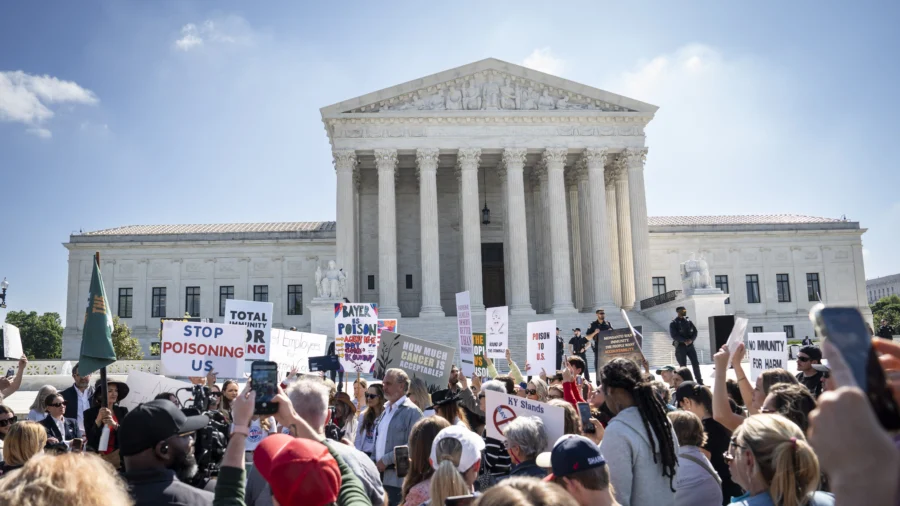
Agribusiness Monsanto scored a significant victory at the Supreme Court on June 25 when the justices reversed a lower court ruling that opened the company up to liability for its weedkiller Roundup.
The justices handed down a 7–2 decision in one of the most consequential decisions this year. They said that a federal law preempted state law that served as the basis for a verdict against Monsanto.
The case, Monsanto v. Durnell, involved a man, John Durnell, who was diagnosed with cancer after exposure to Roundup. A Missouri jury awarded him damages based on the idea that Monsanto had failed to follow a state law requiring warnings about risks for things such as cancer.
Monsanto told the Supreme Court that the verdict was flawed because of a legal doctrine known as preemption, which holds that federal law takes precedence over state law when the two conflict. In this case, Monsanto said that the federal government had already regulated Roundup’s key ingredient, glyphosate, through the Federal Insecticide, Fungicide, and Rodenticide Act (FIFRA).
Under that law, the Environmental Protection Agency (EPA) approved glyphosate’s use and has not required additional labeling related to cancer risks.
“Durnell’s state tort claim would require Monsanto to add a cancer warning to Roundup’s label even though federal law requires Monsanto to use the EPA-approved label without a cancer warning,” Justice Brett Kavanaugh wrote in the majority opinion.
“Because Durnell’s state tort claim would impose a pesticide labeling requirement ‘in addition to or different from’ the label required by EPA, FIFRA expressly preempts Durnell’s claim.”
The June 25 decision reversed a state appellate ruling upholding Durnell’s verdict.
Justices Neil Gorsuch and Ketanji Brown Jackson dissented from the decision.
“Ultimately, the effect of the majority’s interpretation is both remarkable and regrettable, for it unjustifiably closes the courthouse doors to state tort plaintiffs like Durnell,” Jackson wrote.
The majority and dissent disagreed over whether Durnell’s arguments created a conflict with federal law. They focused on a portion of the law that says states “shall not impose or continue in effect any requirements for labeling or packaging in addition to or different from those required.”
Jackson wrote that “FIFRA’s labeling requirements are established by statute and regulation, and those requirements are no different than the labeling duties imposed by Missouri via its failure-to-warn tort.”
Monsanto’s parent company, Bayer, praised the decision in a statement.
“This decision, which reflects strong support across the ideological spectrum of the Court, helps to bring significant containment to the Roundup™ litigation,” the company said.
“Glyphosate remains the most studied crop protection tool in the world and this decision affirms that the EPA’s safety determination is the law of the land, ensuring that companies cannot be punished under a patchwork of state tort laws for complying with federal labeling requirements.”
Questions remained as to how Monsanto and the federal government would continue addressing concerns about glyphosate.
The chemical drew considerable debate as the Make America Healthy Again movement, often associated with Health and Human Services Secretary Robert F. Kennedy Jr., grew in popularity.
As an environmental lawyer, Kennedy notably won a Roundup lawsuit against Monsanto. However, as Health and Human Services secretary, he released a statement supporting President Donald Trump’s executive order aimed at ensuring an adequate supply of the chemical. In the February order, Trump said it was critical to the nation’s food supply and national defense.
Thousands of people were involved with lawsuits against the company; Monsanto noted on June 25 that “billions” of dollars were directed toward the litigation.
Before the Supreme Court’s decision, Monsanto had proposed a nationwide class-action settlement of up to $7.25 billion to resolve claims related to Roundup and non-Hodgkin lymphoma.
Bayer CEO Bill Anderson said in the June 25 statement that the company would continue to pursue the settlement as a way to contain litigation.
The decision provoked criticism from the American Association for Justice, which filed an amicus brief in the case.
“Today’s Supreme Court ruling gifts the manufacturers of dangerous pesticides immunity when they fail to warn Americans that their products can make people sick or kill them, denying individuals the right to hold chemical companies responsible for the mass harm these toxins cause,” CEO Linda Lipsen said in a statement.
Kavanaugh seemed unconvinced of glyphosate’s purported dangers.
“Because EPA has repeatedly concluded that glyphosate is not likely to cause cancer, the agency has not required a cancer warning on Roundup’s label,” he said.
Other aspects of the court’s decision raised questions about the balance of power between states and the federal government.
Durnell’s attorneys had told the court that Missouri had “a right to protect its citizens from the detrimental health effects of dangerous pesticides.”
Although Justice Clarence Thomas agreed with the decision and joined the majority, he also penned a concurrence to criticize FIFRA. He said that the law was constitutionally flawed in that it likely delegated too much of Congress’s power to the EPA and exceeded its authority under the commerce clause.
That portion of the Constitution gives Congress the power to “regulate Commerce with foreign Nations, and among the several States, and with the Indian Tribes.” Thomas said the law went beyond regulating interstate commerce.
“The Act thereby purports to regulate how an individual who owns pesticide products such as Roundup can use those products, even if he bought them at a locally owned store down the street, and even if he seeks to use them in his own backyard,” he said. “Accordingly, the Act is likely unconstitutional in many applications.”