


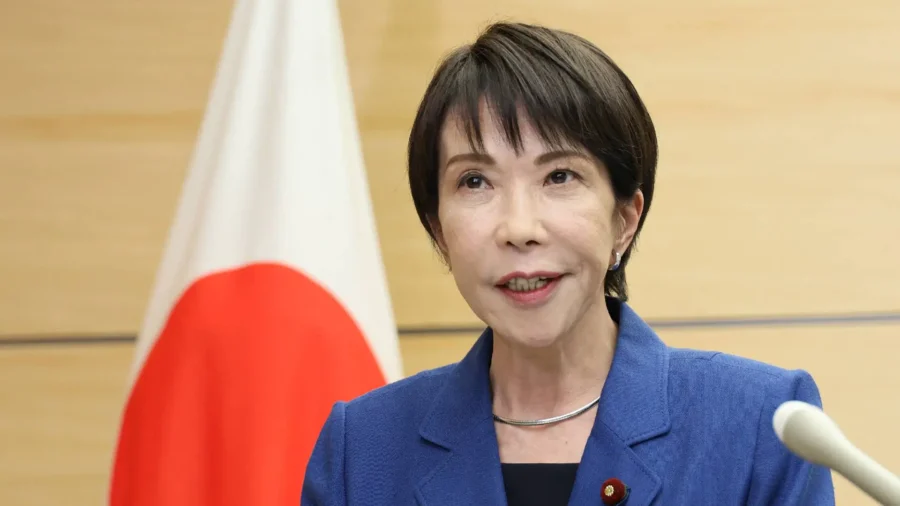
Though China repeatedly asked Japanese Prime Minister Sanae Takaichi to take back her “wrongful remarks,” compounded by aggressive rhetoric and economic coercion, Takaichi refused the demand by saying Tokyo’s security policy is “consistent.”
What did Takaichi say that irked China? In parliament on Nov. 7, she said that Tokyo could become involved in military action if Taiwan were attacked by Beijing—which soon received a threat from Chinese Consul General in Osaka Xue Jian. He posted “cut the dirty neck” in a now-deleted X post.
Beijing’s furious response and economic retaliation quickly followed. It imposed a ban on Japanese seafood imports, blocked new Japanese films, warned Chinese tourists and students to avoid travel to Japan, and suspended a trilateral meeting between the two countries and South Korea, which had been set for Nov. 24.
However, when asked if she planned to retract the comment on Friday before departing for a G-20 meeting in South Africa, she held her ground.
“Regarding a situation threatening Japan’s existence, the government will make a comprehensive judgment based on all available information, taking into account the specific circumstances of each actual situation as it arises,” she said.
“I myself have repeatedly stated this position in my responses. The government’s stance remains consistent.”
She also said Chinese leader Xi Jinping and she agreed on the broad direction to “promote a strategic, mutually beneficial relationship and build a constructive and stable relationship,” and that stance has “absolutely no change” either.
Her remarks echoed Japan’s Foreign Minister Toshimitsu Motegi, who last week said there was no reason for the Prime Minister to withdraw her comment. He also said keeping an open dialogue is important.
Communist China calls Taiwan–an independent island country–part of its territory, though it has never ruled it.
But China’s measures backfired. U.S. Ambassador to Japan George Glass on Thursday denounced China’s recent response as “provocative” and its economic measures as “coercive.”
Taiwan also condemned China as the real regional “troublemaker.” Lin Rei-fan, a senior Taiwanese security official, said so while personally handing out copies of the new civil defence handbook the government is sending to every household on the island as tensions with China rise.
The handbook includes, for the first time, instructions on what to do if citizens encounter enemy soldiers and stresses that any claims of Taiwan’s surrender should be considered false.